

In short
CBT worksheets help a teen aged 12–18 see how thoughts, feelings and actions connect, catch an unhelpful thought and find a more balanced one. In a session, one page and a real conversation are enough. CBT is one of the best-researched therapies for teens with anxiety and low mood.
Many teens arrive with “I’m fine” and a shrug. A worksheet gives them something to do with their hands and a safe way to put a feeling into words – and gives you a clear structure for the session. Below you will find five steps that work, what to say at each one, a filled-in example, a 4-session plan, the research behind it and what to do when a session gets stuck.
What are CBT worksheets for teens and do they work
CBT worksheets are short printable activities based on cognitive behavioural therapy. They help a teen notice a thought, see how it shapes their feelings and actions, and try a more balanced way of thinking. The page itself is only half the work. The conversation after it is where the change happens.
The research behind CBT for young people is strong. A Cochrane review of 87 studies with 5,964 children and teens found that 49% no longer had their main anxiety diagnosis after CBT, compared with 18% of those on a waiting list. For depression, NICE recommends individual CBT as the first treatment for young people aged 12–18 with moderate to severe depression.
These studies look at CBT as a full treatment. Worksheets are a simple way to practise the same skills in sessions and at home.
How do I explain CBT to a teenager
Keep it to one sentence: “Your thoughts, feelings and actions are connected – change one, and the others change too.” Then make it real with an example from their week, not from a textbook.
For example: “You see your friend’s message was read an hour ago and there’s no reply. If you think ‘she’s ignoring me’, how do you feel? And if you think ‘she’s probably busy’, how do you feel then?” Most teens get it straight away – and they feel taken seriously.
Which CBT worksheets help teens most
Five steps do most of the work with teens aged 12–18. Every page below is in the CBT & Mindfulness Kit for Teens, and the steps work best in this order. For each one you will find what to say to start and what to ask after.
1. The Cognitive Triangle – see how it connects
The page shows the three parts – thoughts, emotions and behaviour – with an example about an upcoming test. Then the teen fills in a difficult situation of their own. This is the map for everything that follows.
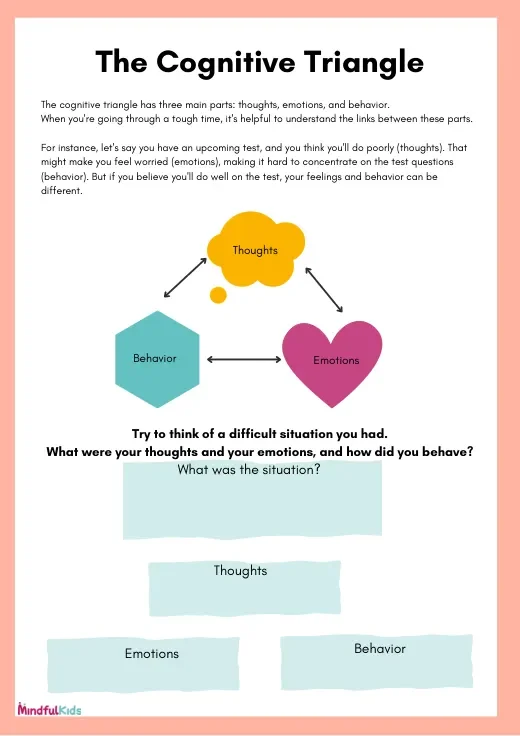
Say: “Let’s take one moment from your week and see how your thoughts, feelings and actions were connected.”
Ask after: “Which part of the triangle would be easiest to change next time?”
2. Reframing Thoughts – catch the first thought
The teen writes what happened, the automatic thought that came up and an alternative thought. The page starts with an example every teen knows: “I texted a friend, he didn’t respond” – “He’s ignoring me” – “He’s busy at the moment.” For a deeper version, the Automatic Thoughts page goes from the facts through thoughts and emotions to behaviour.
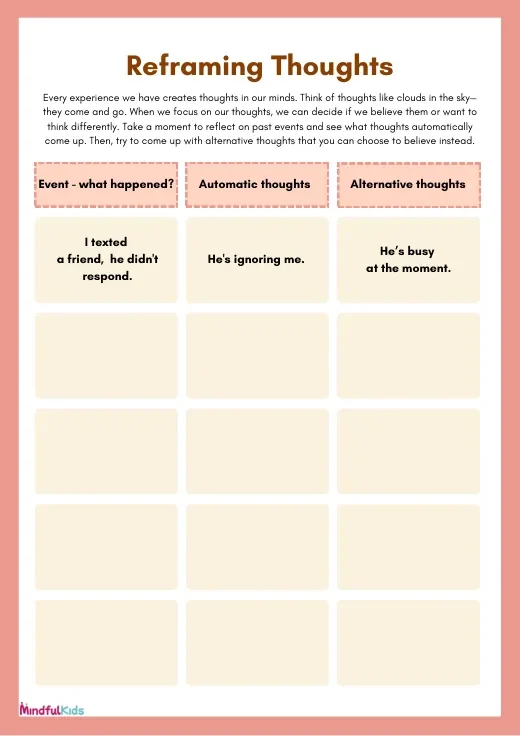
Say: “Your brain gives you a first thought in a split second. Let’s look at it – and find another one.”
Ask after: “How would you feel if you believed the second thought?”
3. Thought Record – check the facts
The teen writes a negative thought about themselves, someone else or the world. Then one event that supports it and one that contradicts it. The page ends with a question that sticks: “Are my thoughts always aligned with what is happening in reality?” You will find a filled-in example further down.
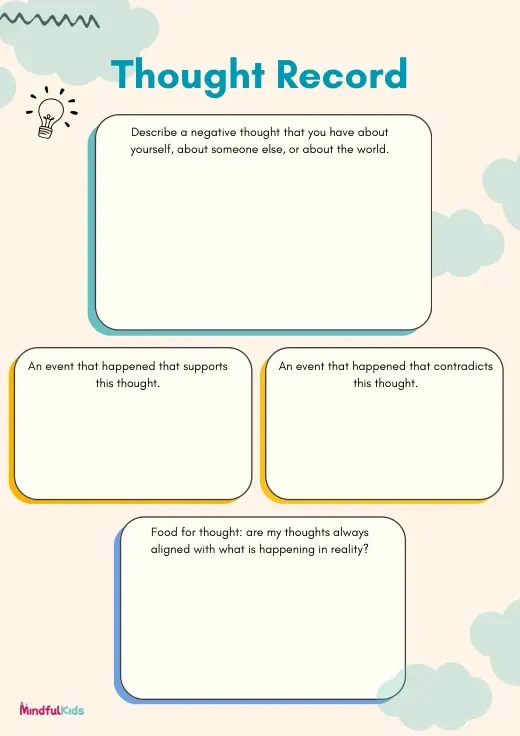
Say: “Let’s treat this thought like a rumour and check the facts.”
Ask after: “What would you say to a friend who had this thought?”
4. Core Beliefs – the glasses we see through
Core beliefs are like glasses that colour everything we see. The page shows two teens with different beliefs – “I’m no fun to be with” and “I’m really fun to be with” – and how each one leads to a different outcome with a new student. Then the teen circles their own positive and negative beliefs.
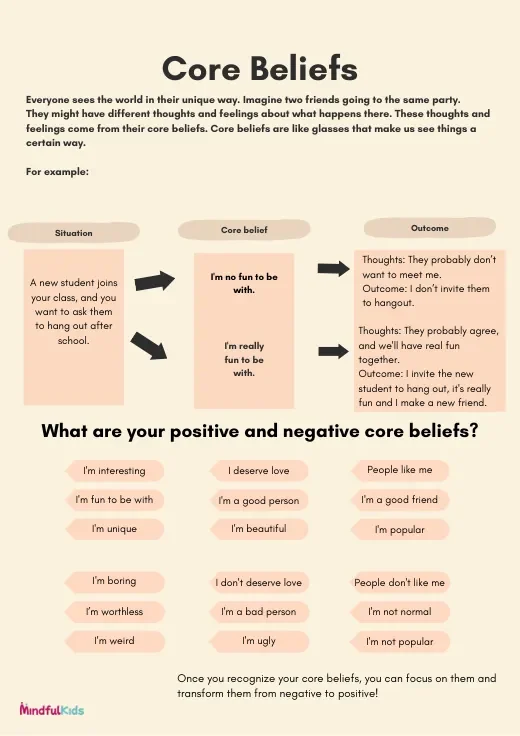
Say: “We all wear glasses that colour how we see things. Let’s find out which ones you wear most days.”
Ask after: “Which positive belief would you like to wear more often?”
5. STOP and Riding the Waves – tools for the hard moment
STOP is four steps for when a negative thought pops up: Stop, Take a breath, Observe, Proceed. Riding the Waves shows how a strong feeling rises, peaks and fades on its own when you stay with it instead of reacting. Together they give the teen something to do in the moment – in class, at home or late at night.
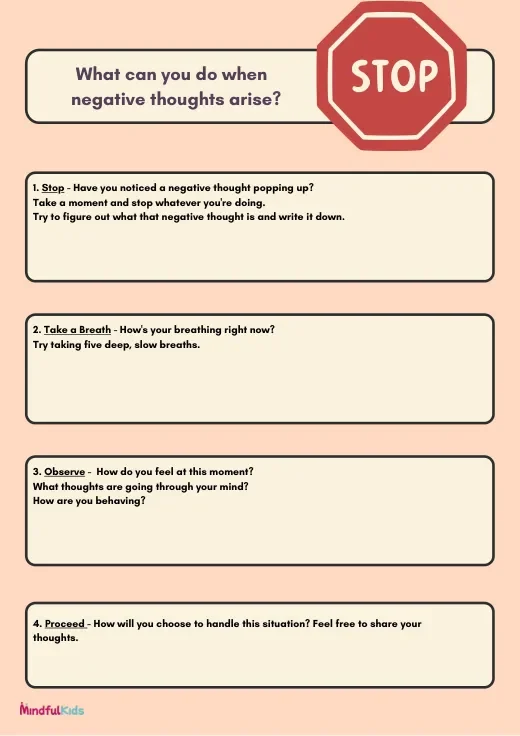
Say: “Strong feelings are like waves. They rise, they peak and they pass. Let’s practise riding one.”
Ask after: “When this week could you use STOP?”
Example: a filled-in Thought Record
Here is how a 15-year-old might fill in the Thought Record page.
| On the page | What Lena (15) wrote |
|---|---|
| A negative thought | Everyone in my class thinks I’m weird. |
| An event that supports this thought | Nobody sat next to me at lunch on Monday. |
| An event that contradicts this thought | Mila asked me to be in her group for the history project. Two people laughed at my joke in maths. |
| Are my thoughts always aligned with reality? | Not everyone thinks I’m weird. Monday was one bad lunch. |
Notice that Lena didn’t have to think “everyone loves me”. She moved from “everyone” to “one bad lunch” – a smaller, truer thought. That is exactly what CBT aims for, and she found it herself. You don’t need to fix the belief in one session. Helping the teen check the facts is the work.
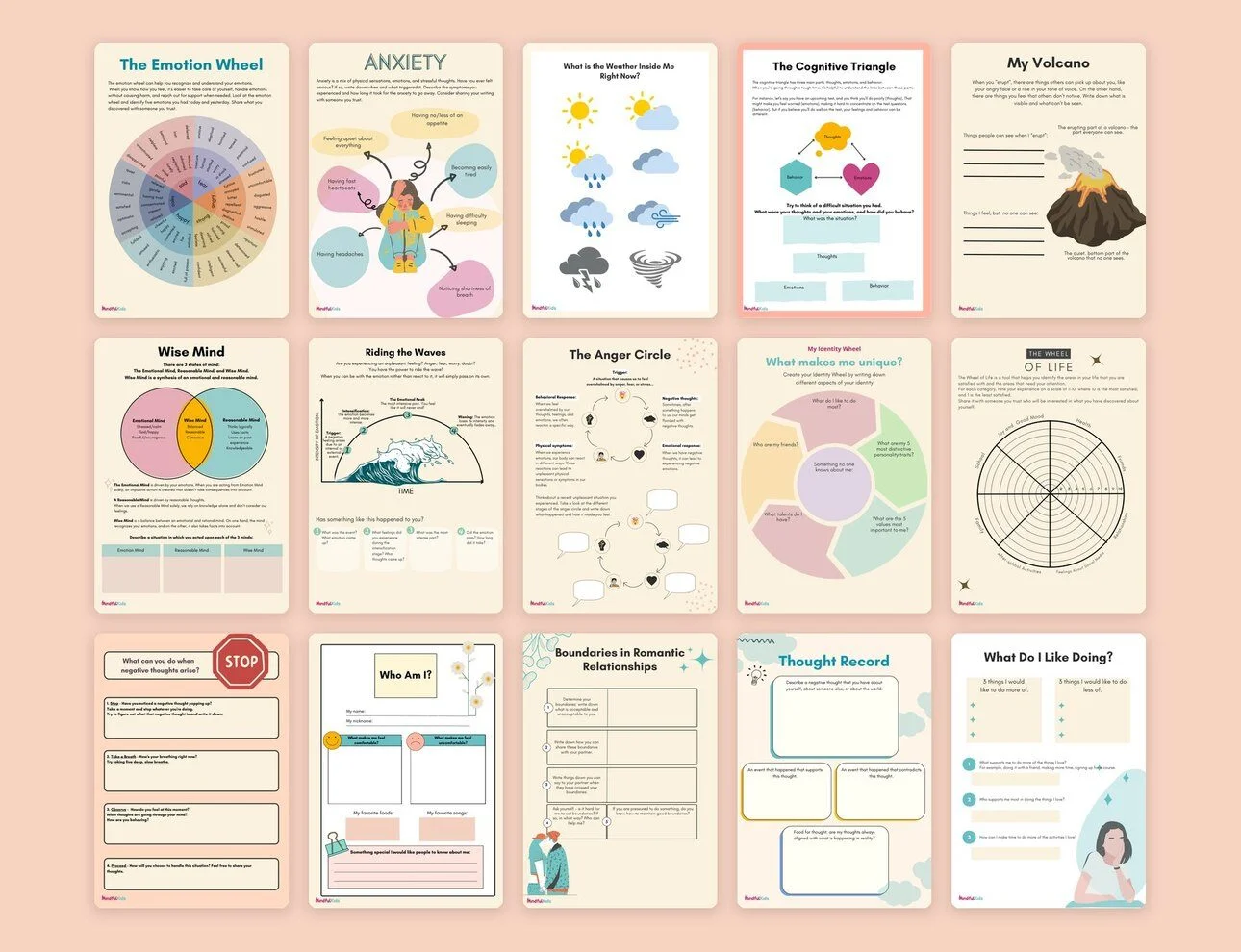
All these pages are in this kit
CBT & Mindfulness Kit for Teens (12–18)
Over 50 printable worksheets for teens. Instant PDF download, 30-day money-back guarantee.
How do I run a worksheet session with a teen
Every session can follow the same rhythm:
- Let the teen choose. Lay out two or three pages that fit where you are in the plan, and let them pick. Teens engage much more with a page they chose.
- Fill it in side by side. You can fill in your own copy too, with an everyday example of your own. It makes the page feel less like a test.
- Talk about it. Listen more than you speak. Reflect what you hear: “So the silence in the group chat felt like a verdict.”
- Agree on privacy. Tell the teen that what they write is theirs. Agree together where the page is kept and that you won’t show it to anyone without asking.
- Look again later. After a few weeks, take the page out and compare. Teens are often surprised by how much has changed.
Three questions that work after any page: “What surprised you?”, “Which part was the hardest?” and “What will you take with you this week?”
Before you start, agree together where phones go during the page – face down on the table works for most teens. A calm room and a choice make it easier to open up.
How often should I use them
One page per session works best, plus time to talk. Between sessions, a page the teen already knows – such as STOP or Riding the Waves – can go home as practice. If a teen arrives very upset, start with breathing or the 5-4-3-2-1 Senses page and do the CBT page later.
A 4-session plan
| Session | Focus | Pages from the kit |
|---|---|---|
| 1 | Get to know the teen | A List of Things I’m Good At, then The Cognitive Triangle. |
| 2 | Catch the thought | Reframing Thoughts, then Automatic Thoughts with a situation from their week. |
| 3 | Check the facts | Thought Record, then Core Beliefs. |
| 4 | Tools for hard moments | STOP and Riding the Waves, plus What Helps Me Calm Down When I’m Stressed. A look back at the session 1 triangle. |
After four sessions, keep the pages the teen found most useful close by, and go back to them whenever a new situation comes up.
What if a session gets stuck
It happens to everyone who works with teens, and it is part of the process.
- “I don’t know”: offer two options to choose from, or ask: “If you did know, what might it be?” Many teens answer straight away.
- The teen shrugs or goes quiet: let them write instead of talk. Writing often feels safer, and the page gives you something concrete to ask about.
- The teen is only there because a parent sent them: say so openly. “You didn’t choose to come. Let’s see if we can make this time useful for you.” Then let them choose the page.
- Strong feelings come up: stay calm and curious. “It makes sense that this is hard.” Use STOP together and come back to the page later – or next time.
The process matters more than the result. A session where the teen fills in one box is still a good session. For more ideas, see our post on getting through to teenage clients.
How do I involve parents
Parents can support the work between sessions – while the teen’s privacy stays protected.
- Share the skill, not the content. Tell parents what the teen is practising, for example STOP. Share what the teen wrote only with their permission.
- Give parents one tip: when their teen is upset, listen first and ask “what would help right now?” instead of giving advice straight away.
- Agree with the teen what you will tell their parents before you meet them.
When the hardest part is anger, see Anger worksheets for teens (12–18).
Questions people ask
What age are CBT worksheets for teens for?
For ages 12–18. With 12–14-year-olds, use concrete examples from school and friends. Older teens can often fill in a page on their own and talk it through with you.
How do I explain CBT to a teenager?
Keep it to one sentence: your thoughts, feelings and actions are connected – change one, and the others change too. Then show it with the Cognitive Triangle and an example from their week.
What is a thought record?
A thought record is a page where a teen writes down a negative thought, then the facts that support it and the facts that don’t. It helps them check whether the thought matches what really happened.
Can I use CBT worksheets with a group of teens?
Yes. Let each teen fill in the page on their own and keep sharing optional. Small groups work best, and pages like the Cognitive Triangle or Riding the Waves are easy to discuss together.
What if a teen won’t talk in the session?
Start with a page they can fill in quietly, and talk afterwards. Writing often feels safer than speaking, and the page gives you something concrete to ask about.
Working with a teen who has ADHD? Read ADHD in teens gets quieter.
Worksheets for this topic
CBT & Mindfulness Kit for Teens (12–18)
Over 50 printable CBT and mindfulness worksheets for teens. Instant PDF download, 30-day money-back guarantee.