
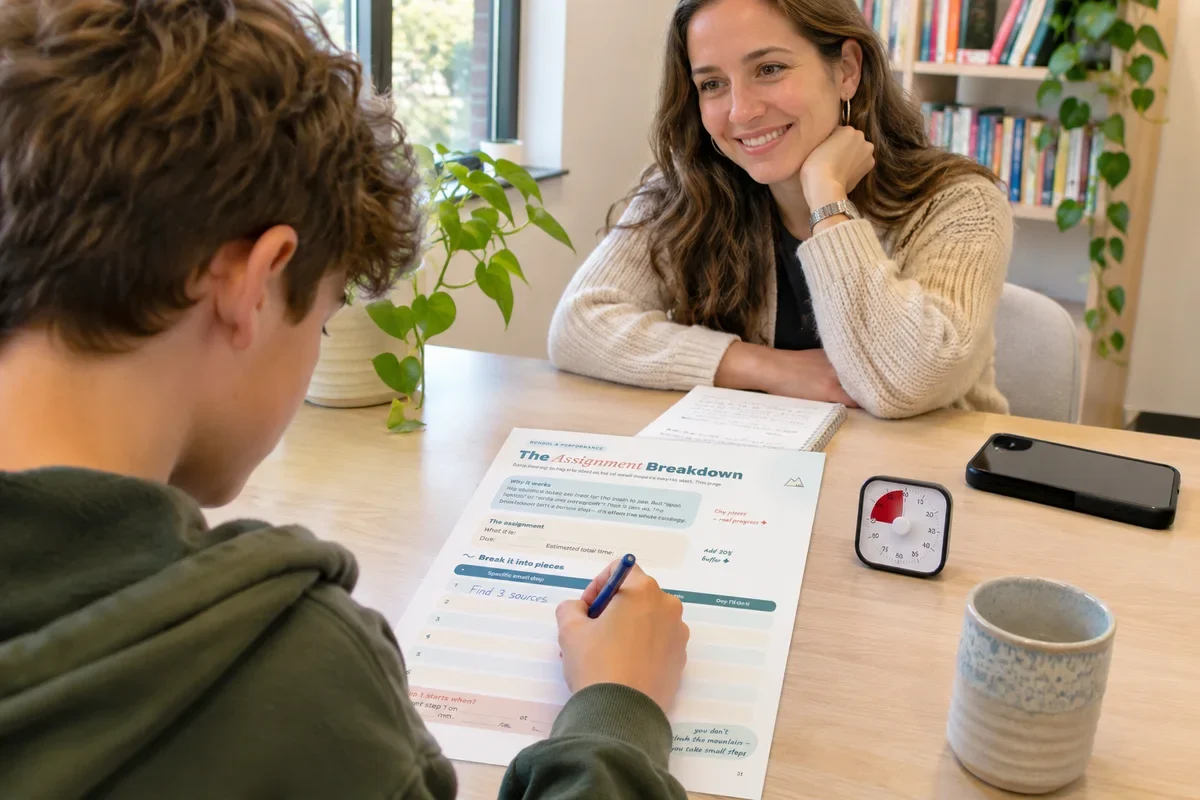
You know this teenager. At eight, he couldn’t stay in his chair. At fifteen, he sits across from you and barely moves. His teacher is relieved. His parents say he’s finally settling down.
He hasn’t handed in an essay since September.
When researchers followed 1,374 children all the way to age 17, this is what they found. The restlessness faded, year after year. The trouble paying attention didn’t move an inch. (Vergunst et al., 2019)
The shape of the finding, simplified. Source: Vergunst et al., 2019.
So if the teen opposite you looks calm and you still sense something is hard for him, you’re reading him right. At this age, ADHD is mostly the quiet part: getting started, planning, remembering, and feelings that arrive at full volume.
One more thing that helps before the first session. In a large US survey, 77% of teens with ADHD also had another condition, most often anxiety, at 43%. (Danielson et al., 2024) So if he was sent to you “for anxiety”, you’re not on the wrong track. You may simply be looking at both.
Five places the quiet part hides
He can’t get started
The laptop is open. So is the document. An hour later there’s one sentence, and it’s the title.
Here’s the good news: this is where your work pays off most. Across 16 trials with teenagers, skills training made its biggest difference on exactly this kind of thing, like finishing homework and using a planner. Bigger than on the symptoms themselves. (Chan et al., 2016)
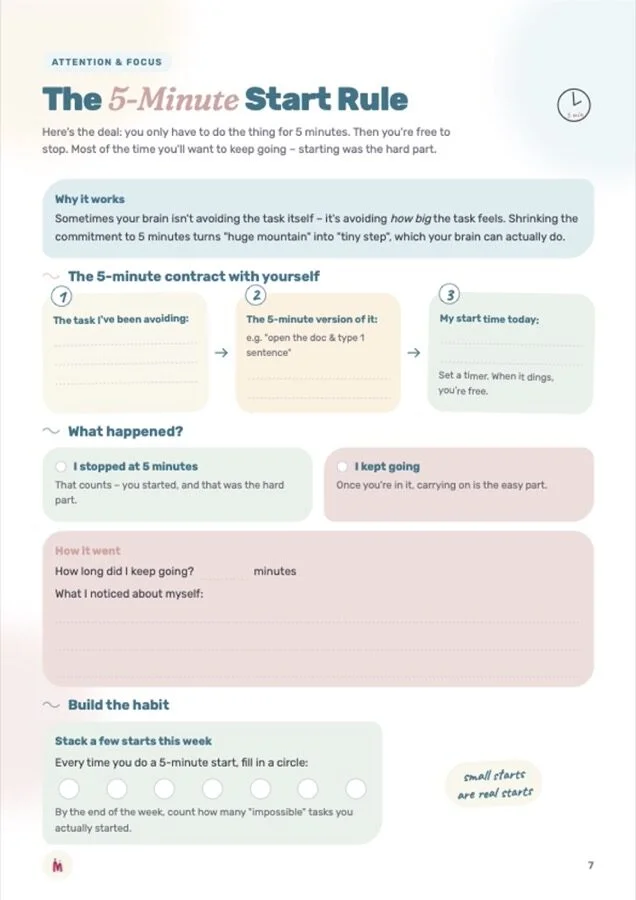
Try: The 5-Minute Start Rule. He commits to five minutes, nothing more. When the timer rings, he ticks “I stopped at 5 minutes” or “I kept going”. Both count. He can’t fill it in wrong, and neither can you.
Deadlines only feel real the night before
Ask him when the history project was set. Three weeks ago. When did it start to feel real? Last night.
That gap can be trained. In 12 trials, organisation skills training made children and teens more organised: a moderate change in their teachers’ eyes, a big one in their parents’. (Bikic et al., 2017)
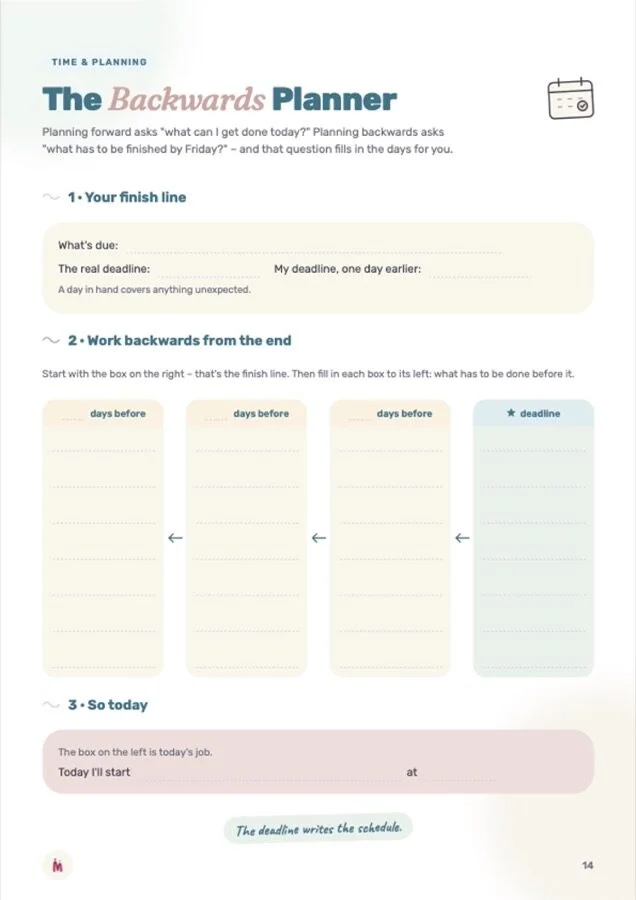
Try: The Backwards Planner. He writes the deadline, moves it one day earlier for “a day in hand”, and fills the boxes from there back to today. The deadline writes the schedule, so he doesn’t have to.
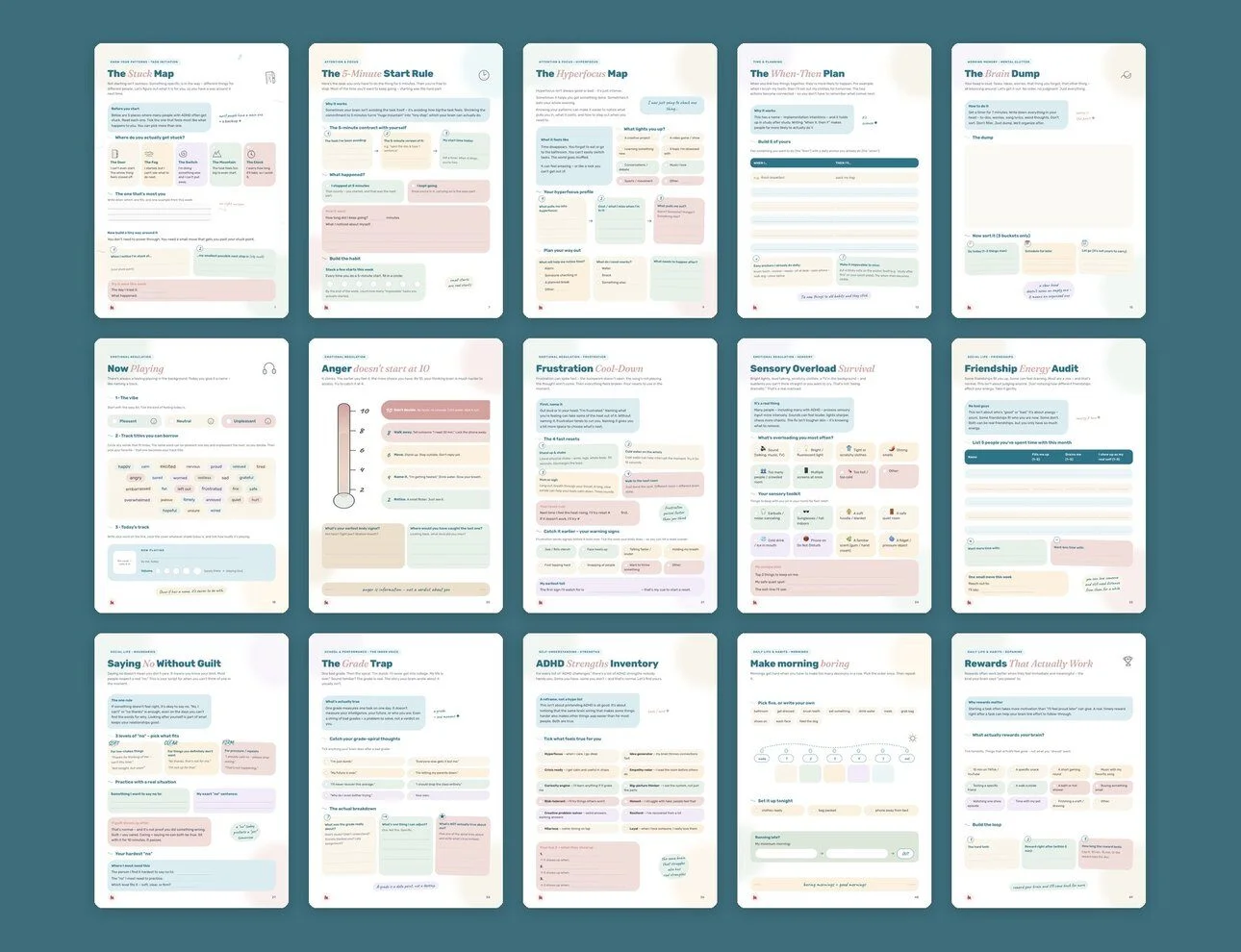
The pages in this article come from this workbook
ADHD for Teens
50 printable worksheets for teens with ADHD. Instant PDF download.
Small things land like a slammed door
You say something mild. His face closes.
You didn’t do anything wrong. Across 77 studies with 32,044 young people, the biggest emotional difference in ADHD was reactivity: big, fast feelings that swing quickly. That link was even stronger in studies of older youth. (Graziano & Garcia, 2016)
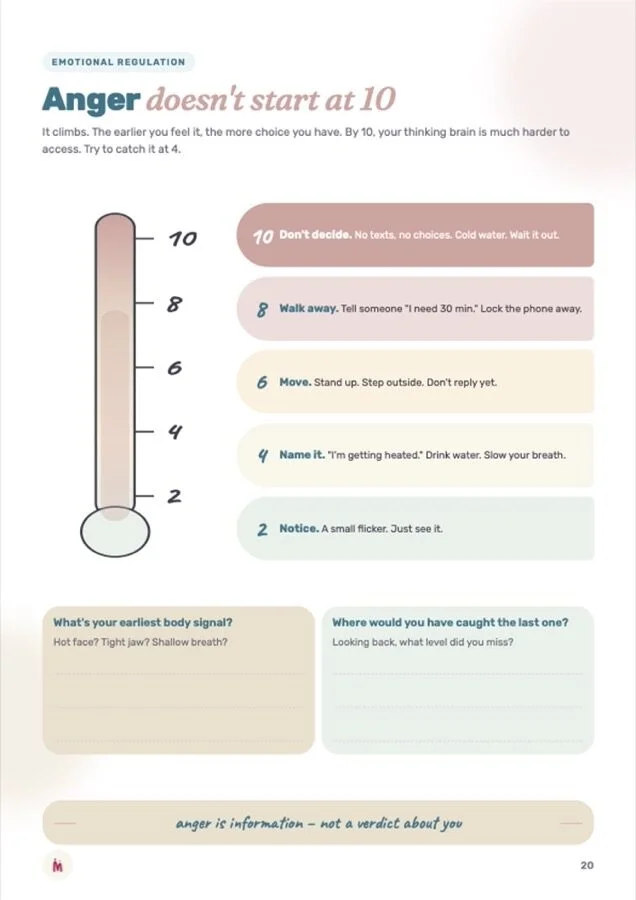
Try: Anger doesn’t start at 10. A ladder from 1 to 10, with one move for each level. He looks back at the last blow-up and finds the level he missed. The goal is to catch it at 4, and that is something you can practise together.
He’s tired all the time
Midnight is the first moment all day when nobody wants anything from him. So he stays up.
Across 13 studies, teens with ADHD reported worse sleep and more daytime sleepiness than other teens. (Marten et al., 2023) If he’s foggy in your session, that may be part of the picture.
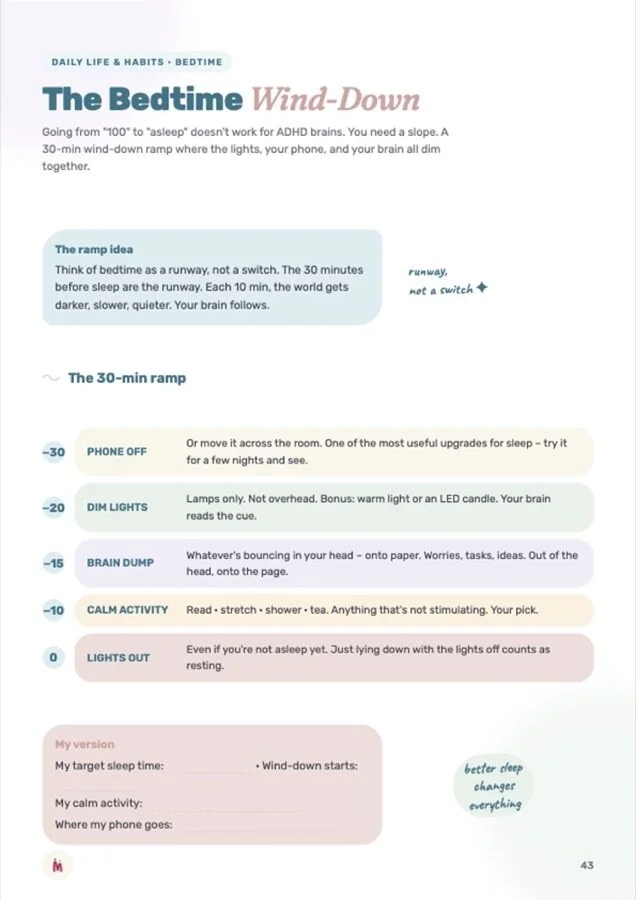
Try: The Bedtime Wind-Down. Bedtime as a runway, not a switch. Phone away at 30 minutes, lamps only at 20, a brain dump at 15, something calm at 10.
“I’m just lazy”
He says it like a fact. Like his height.
This finding surprises most people. In a Canadian study, the inattentive symptoms predicted how much young people believed the bad things said about ADHD. The hyperactive symptoms didn’t. And the more they believed it, the lower their self-esteem. (Jelinkova et al., 2024)
The quiet symptoms carry the heaviest label.
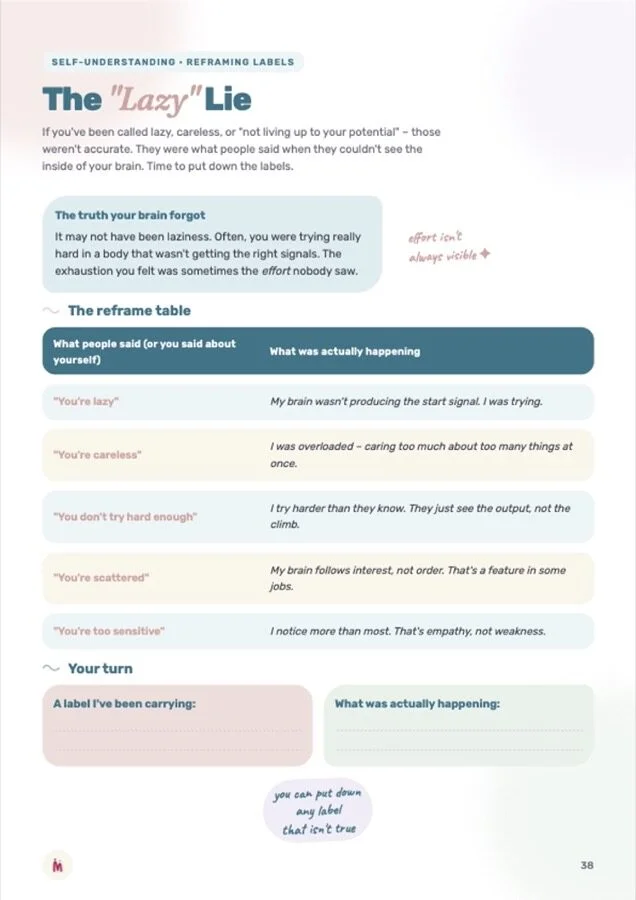
Try: The “Lazy” Lie. On the left, what people said. On the right, what was really happening. “You’re lazy” becomes “My brain wasn’t producing the start signal. I was trying.” Then he writes one label of his own. The workbook’s guide calls this the page that often changes the temperature of the room.
Not sure where to begin? Listen for the sentence
You don’t need to work out a plan before he arrives. Go with what he walks in carrying.
| If he says… | Reach for |
|---|---|
| “I know what to do. I just can’t start.” | 07 The 5-Minute Start Rule |
| “It’s due Friday and I haven’t even…” | 14 The Backwards Planner |
| “I just snapped. I don’t know why.” | 20 Anger doesn’t start at 10 |
| “I’m tired all the time.” | 43 The Bedtime Wind-Down |
| “I’m just lazy.” | 38 The “Lazy” Lie |
Three small moves that help any page land. Put it on the table between you instead of handing it over, so it feels like shared work. Read the first lines out loud, then stop and let him react. And if he wants to take two pages home, give him one. These come from the workbook’s own guide for therapists.
Read next: ADHD in teenage girls: why it’s found so late
All these pages are in this workbook
ADHD for Teens
All five pages above, plus 45 more: starting, planning, emotions, friendships and self-understanding. Every page stands alone. Instant PDF download. 30-day money-back guarantee.
Questions people ask
At what age does ADHD get quieter?
Gradually. In the study above, restlessness went down little by little from toddlerhood to 17, while attention trouble stayed level the whole way.
Can I use these pages with a teen who has no diagnosis?
Yes. The pages work on everyday skills such as starting, planning and calming down. A diagnosis is a question for a qualified assessment; the skills help either way.
How long does one page take in a session?
The workbook’s guide suggests about ten minutes of writing. The rest of the session belongs to the conversation that comes out of it.
Sources
- Vergunst F, et al. Multi-rater developmental trajectories of hyperactivity-impulsivity and inattention symptoms from 1.5 to 17 years. Eur Child Adolesc Psychiatry, 2019. PubMed
- Danielson ML, et al. ADHD prevalence among U.S. children and adolescents in 2022. J Clin Child Adolesc Psychol, 2024. PMC
- Chan E, Fogler JM, Hammerness PG. Treatment of ADHD in adolescents: a systematic review. JAMA, 2016. PubMed
- Bikic A, et al. Meta-analysis of organizational skills interventions for children and adolescents with ADHD. Clin Psychol Rev, 2017. PubMed
- Graziano PA, Garcia A. ADHD and children’s emotion dysregulation: a meta-analysis. Clin Psychol Rev, 2016. PubMed
- Marten F, et al. Sleep parameters and problems in adolescents with and without ADHD: a systematic review and meta-analysis. JCPP Advances, 2023. PubMed
- Jelinkova K, et al. Self-stigma of Canadian youth with ADHD and their parents. J Atten Disord, 2024. PubMed