
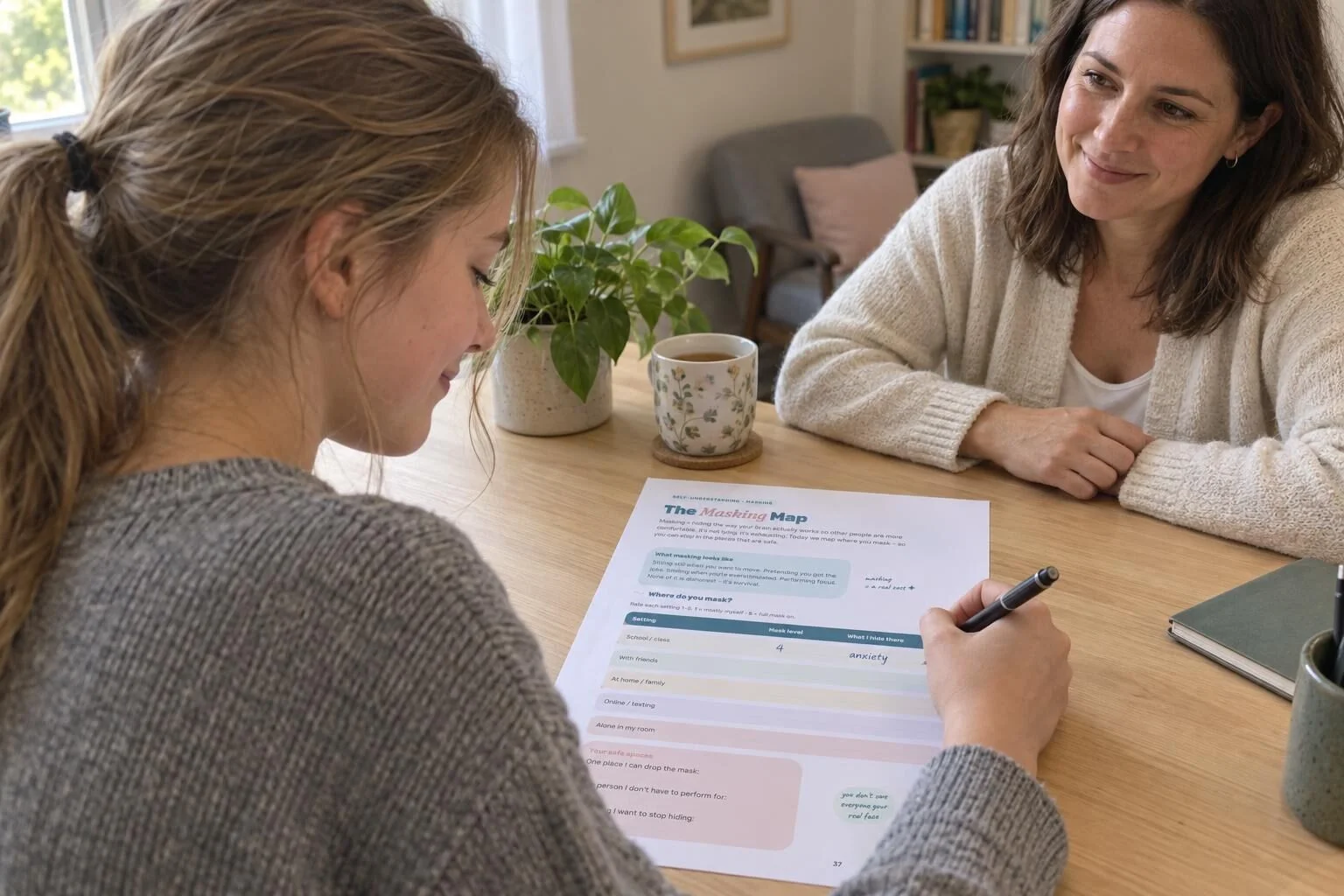
She has the neatest notes in the class. Her homework comes in on time, sometimes finished at two in the morning. Teachers like her. Friends lean on her. At home, the bedroom door closes and there is nothing left.
Would ADHD be on your list?
Researchers in Denmark looked at 1.3 million children and asked at what age each diagnosis is most often given. For ADHD in boys, the peak was 8. For girls, it was 17. (Dalsgaard et al., 2020)
Age at which new ADHD diagnoses peak, Denmark. Source: Dalsgaard et al., 2020.
Nine years. For many girls, that is most of their school life without a name for what is hard. The researchers put it carefully: “possible delayed detection”.
If you’ve ever sat with a girl like this and wondered, this is for you. The research gives you three clear reasons she gets missed, and every one of them is something you can learn to spot.
Three reasons she gets missed
She moves less, and struggles just as much
When researchers pooled the studies that compared girls and boys with ADHD, the boys were more hyperactive. But the girls had the same difficulties with planning, switching and holding back. (Loyer Carbonneau et al., 2021)
Less for others to see. Just as much for her to manage.
She has to be struggling more before anyone looks
A study looked at 283 children who all had high ADHD symptoms, and asked which of them met the full diagnosis. For girls, emotional problems were a key part of the difference. For boys, they weren’t. Parents also rated girls’ hyperactivity lower than an independent interviewer did, and boys’ higher. (Mowlem et al., 2019)
The researchers’ conclusion: a girl’s ADHD may need extra emotional or behavioural problems on top before it becomes visible.
She learns to hide it, early
Camouflaging means working hard to look like everyone else: copying, compensating, covering. In a study of 119 girls aged 11 to 14, it was already there by early adolescence, and it was higher in the older girls. The more a girl camouflaged, the higher her anxiety and depression scores. (McKinney et al., 2024)
A group of experts on girls and women with ADHD says the same thing in clinical language. Her coping strategies can mask the ADHD underneath, so look past ADHD as a behaviour problem, and attend to the “more subtle and/or internalised presentation” that is common in girls. (Young et al., 2020)
If she comes to you for anxiety, you’re not wrong to wonder. In the Danish data, anxiety was the most common diagnosis in girls by 18, and ADHD the most common in boys. (Dalsgaard et al., 2020) If you suspect ADHD, the next step is a referral for a proper assessment. Noticing is already a big part of the work.
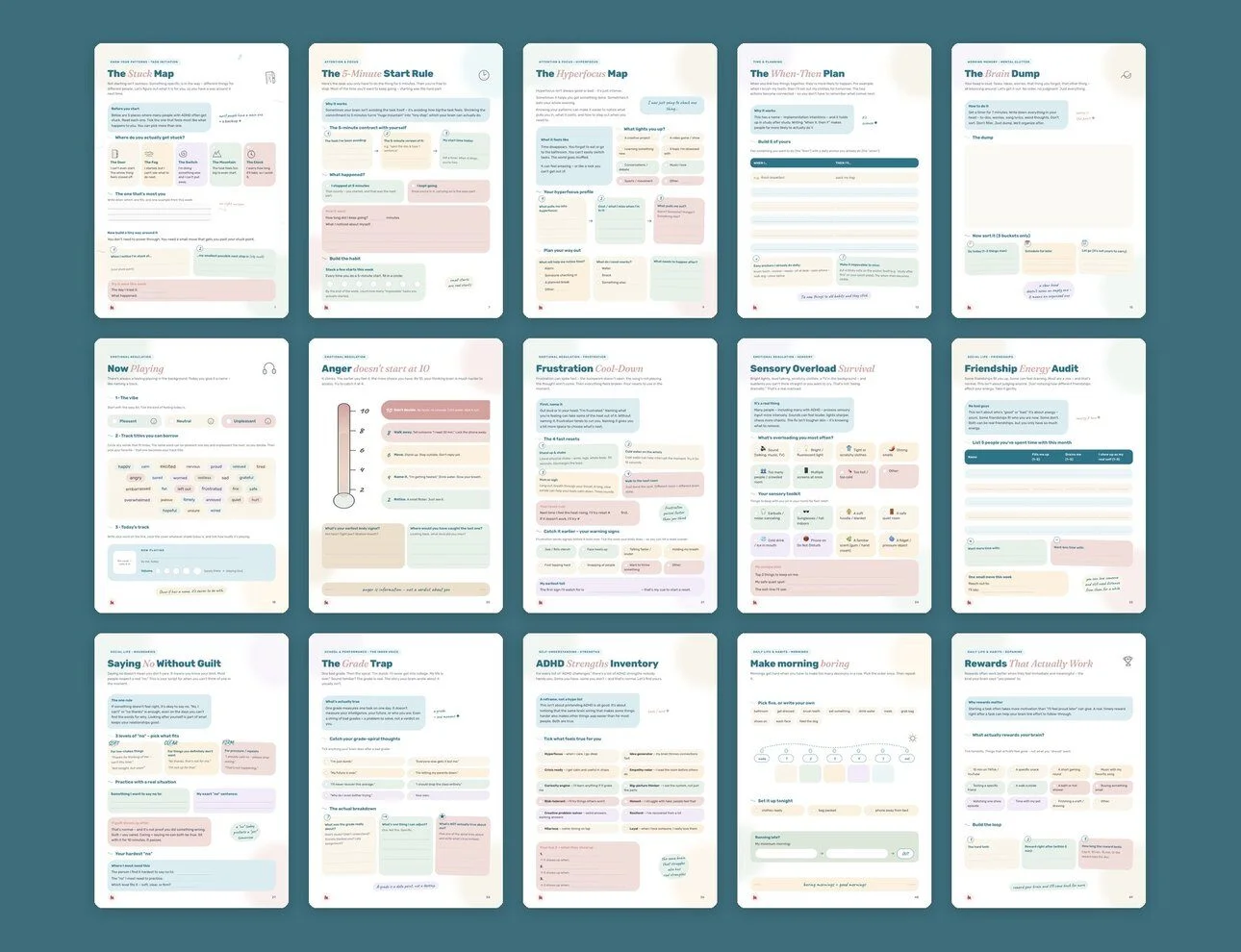
The pages in this article come from this workbook
ADHD for Teens
50 printable worksheets for teens with ADHD, including pages on feelings, masking and strengths. Instant PDF download.
What to listen for
You don’t need a checklist. These four questions tend to open more doors:
- “How much effort does a normal school day take you?”
- “Where can you stop holding it together?”
- “What happens the night before something is due?”
- “When did someone last really get how your head works?”
Listen for the gap between how things look and what they cost her. That gap is where the camouflaging lives.
Four pages, in the order you’ll need them
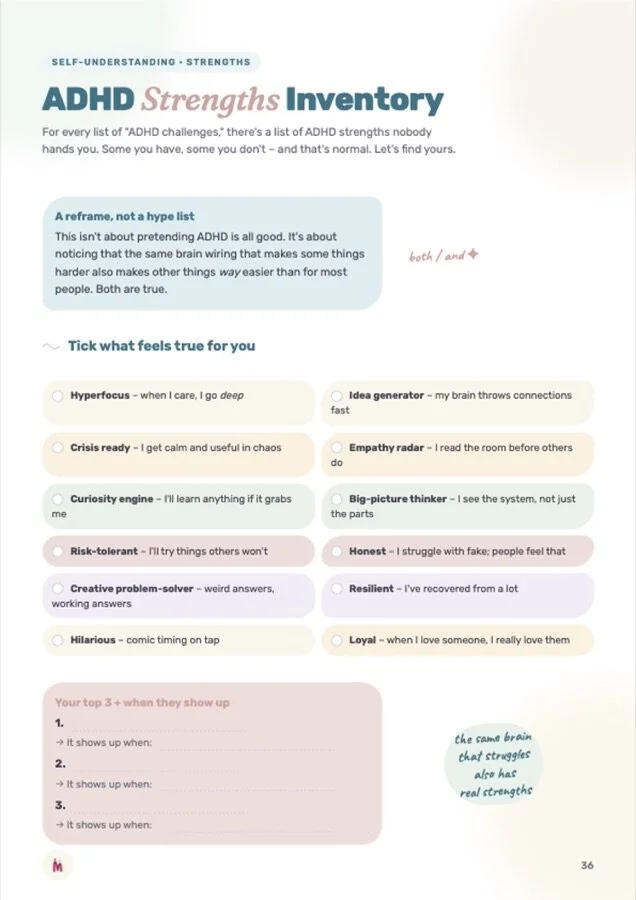
First session, “everything’s fine”: Now Playing
There is always a feeling playing in the background, and this page asks her to name it like a song. It asks for a name, not an explanation, which is why it works when she isn’t ready to talk. She circles words, picks today’s track title and colours the cover.
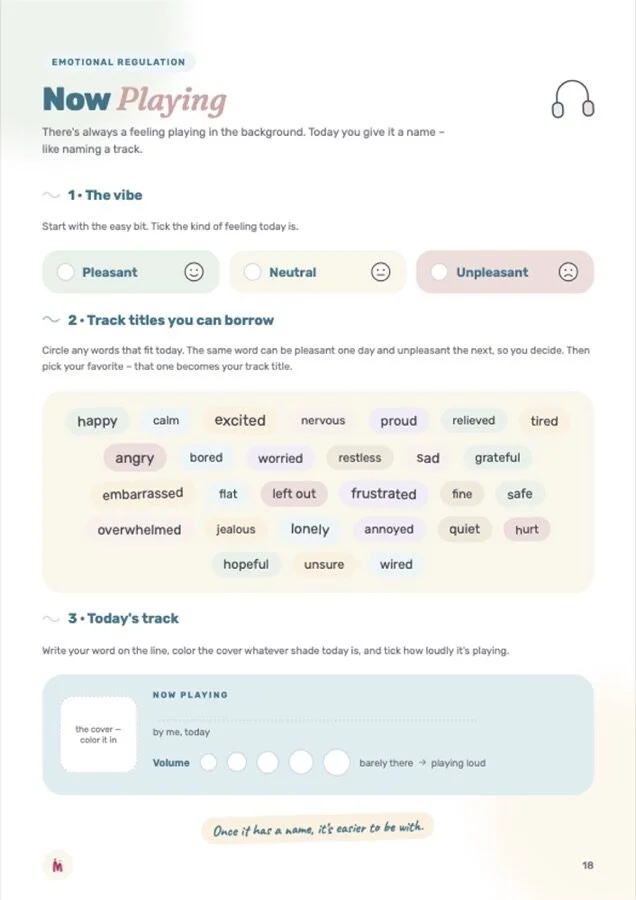
A parent made her come: Strengths Inventory
Nothing on this page asks anything of her, and nothing is being fixed. It calls itself “a reframe, not a hype list”. She ticks what feels true, like hyperfocus, an empathy radar or staying calm in a crisis.
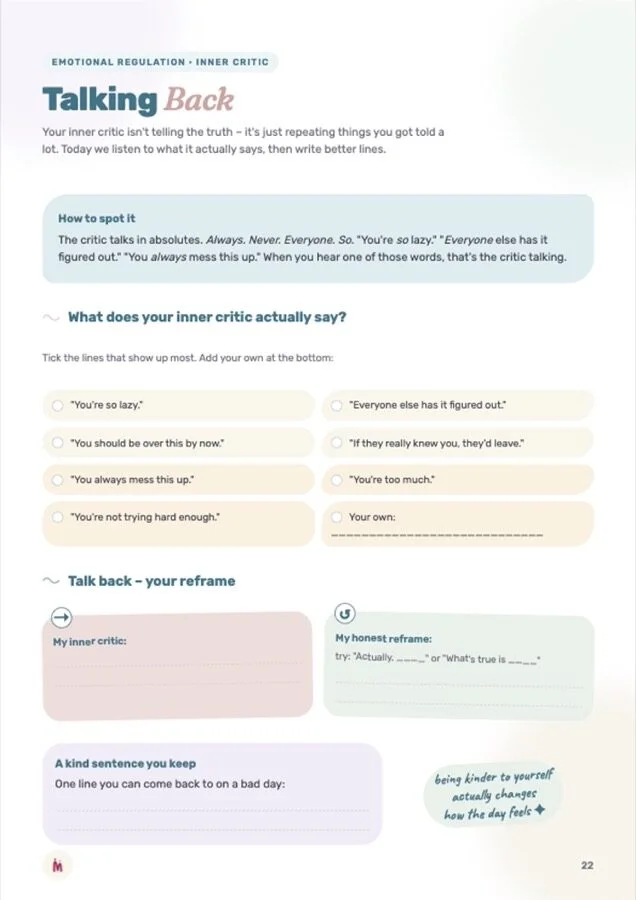
The inner critic is loud: Talking Back
The critic talks in absolutes: always, never, everyone. She ticks the lines she hears most, like “Everyone else has it figured out” or “You’re too much”, and writes an honest answer back.
Later, once there is trust: The Masking Map
She rates how much she masks at school, with friends, at home, online and alone. Then she names one place and one person where she can drop the mask. The workbook’s guide suggests saving this one for later, because masking tends to be strongest in a new room, with a new adult.
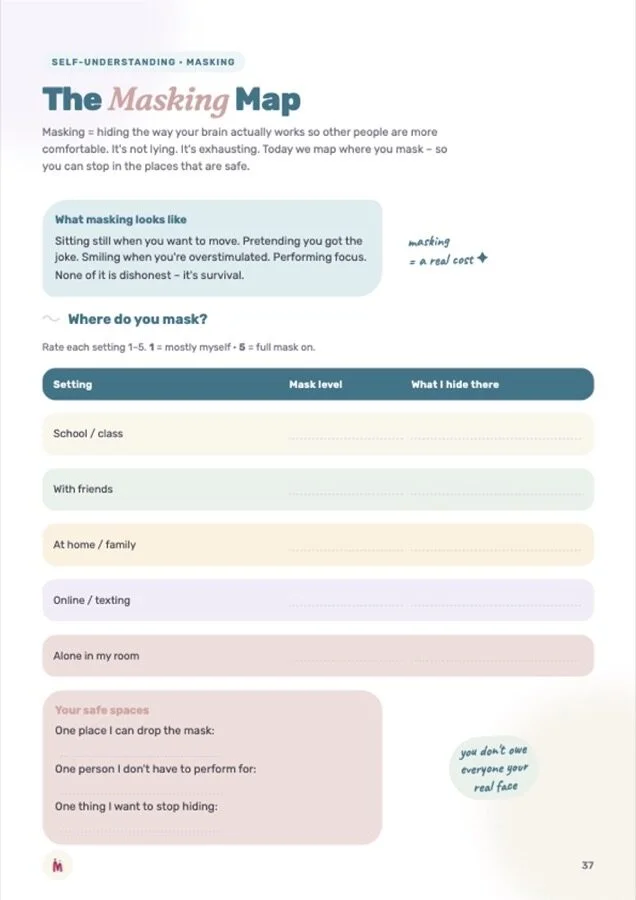
“you don’t owe everyone your real face”
When the name finally comes
In a 2025 study, 28 women who were diagnosed with ADHD as adults described what the late diagnosis had meant. Many spoke of years of criticism and low self-esteem. And they described the diagnosis itself as revelatory: their lives finally made sense, and it brought healing and better self-esteem. (Holden et al., 2025)
Those women were looking back on decades. The girl in your room at fifteen is still at the start. You might be the one who notices.
Read next: ADHD in teens gets quieter
All these pages are in this workbook
ADHD for Teens
All four pages above, plus 46 more, for feelings, masking, strengths, school and friendships. Instant PDF download. 30-day money-back guarantee.
Questions people ask
Why is ADHD diagnosed later in girls?
Research points to three reasons. Girls with ADHD tend to be less hyperactive, so there is less to see. Their ADHD often needs extra emotional problems on top before it is recognised. And many learn early to camouflage.
Is ADHD in girls a different condition?
No, the diagnosis is the same. In a meta-analysis, girls were less hyperactive than boys but had the same executive difficulties.
Can I use these pages before there is a diagnosis?
Yes. The pages work on feelings, strengths and everyday skills. A diagnosis is a question for a qualified assessment.
Sources
- Dalsgaard S, et al. Incidence rates and cumulative incidences of the full spectrum of diagnosed mental disorders in childhood and adolescence. JAMA Psychiatry, 2020. PubMed
- Loyer Carbonneau M, et al. Meta-analysis of sex differences in ADHD symptoms and associated cognitive deficits. J Atten Disord, 2021. PubMed
- Mowlem F, et al. Do different factors influence whether girls versus boys meet ADHD diagnostic criteria? Psychiatry Res, 2019. PubMed
- McKinney A, et al. Camouflaging in neurodivergent and neurotypical girls at the transition to adolescence and its relationship to mental health. JCPP Advances, 2024. PubMed
- Young S, et al. Females with ADHD: an expert consensus statement taking a lifespan approach. BMC Psychiatry, 2020. PubMed
- Holden E, et al. Adverse experiences of women with undiagnosed ADHD and the invaluable role of diagnosis. Sci Rep, 2025. PubMed