
In short
Anxiety worksheets give a child aged 4–11 a safe way to name a worry, make a small plan and calm the body. In a session, one page and a short talk are enough. They are built on CBT, the best-studied approach for childhood anxiety, and most children improve with it.
An anxious child often can’t put the worry into words. A worksheet gives them a way in – and gives you a clear structure for the session. Below you will find five steps that work, what to say at each one, a filled-in example, a 4-session plan, the research behind it and what to do when a session gets stuck.
What are anxiety worksheets and do they work
Anxiety worksheets are short printable activities based on cognitive behavioural therapy (CBT) and mindfulness. They help a child notice a worry, put it into words and try a calming step. The page itself is only half the work. The talk after it is where the change happens.
CBT has strong research behind it. According to the University of Groningen, about 50–70% of children no longer have an anxiety disorder after CBT treatment. The same source says about 1 in 10 young people in the Netherlands has an anxiety disorder.
Mindfulness adds to this. A review of 33 randomised trials with 3,666 children and teens found that mindfulness training lowered anxiety and stress (Dunning et al., 2019). And anxiety is common everywhere: the CDC reports that 11% of US children aged 3–17 have a diagnosed anxiety problem.
The research looks at CBT and mindfulness programmes. Worksheets are a simple way to practise the same skills at home or in sessions. These numbers are also useful when a parent asks you whether this will help their child.
What age are anxiety worksheets for
Anxiety worksheets work from about age 4 to 11, as long as you adapt how the child fills them in.
- Ages 4–6: read every question aloud and write the answers for the child. Let them draw or point instead of writing.
- Ages 7–11: explain why you are doing the page together. Let the child choose to write or draw, and add an extra sheet if they want more space.
At every age, thank the child for the effort – even when the answers are not what you expected.
How do I explain anxiety to a child
Explain a worry as a visitor: it comes, it stays for a while, and it leaves again. You can say: “A worried thought came to visit you,” instead of “You are a worrier.” This small change helps the child see the worry as something they have, not something they are.
The NHS uses a similar picture: anxiety is like a wave that builds up and then passes. Then ask: “Where do you feel the visitor in your body?” A tummy, a fast heart, hot cheeks – once a child can name it, they can spot it early next time.
Which worksheets help an anxious child most
Five steps do most of the work with anxious children aged 4–11. Every page below is in the CBT & Mindfulness Kit for Kids, and the steps work best in this order. For each one you will find what to say to start and what to ask after.
1. My Five Strengths – start with what is good
Start with strengths before you talk about worries. The child writes one strength or talent inside each finger of a hand. A child who feels capable opens up much more easily about what is hard – and the session starts with a success for both of you.
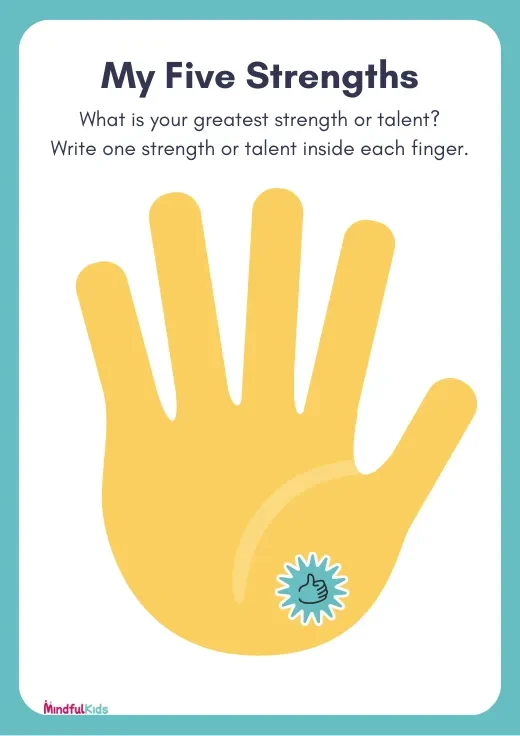
Say: “Before we talk about anything hard, let’s find out what you’re good at.”
Ask after: “Which strength could help you when you feel worried?”
2. When I’m Worried I… – see what worry looks like
The child draws their worried face, then writes four things that make them worried and four ways they show it. Worry looks different in every child: one goes quiet, another gets angry, a third gets tummy aches. This page shows you how this child’s worry looks – and helps the child recognise it too.
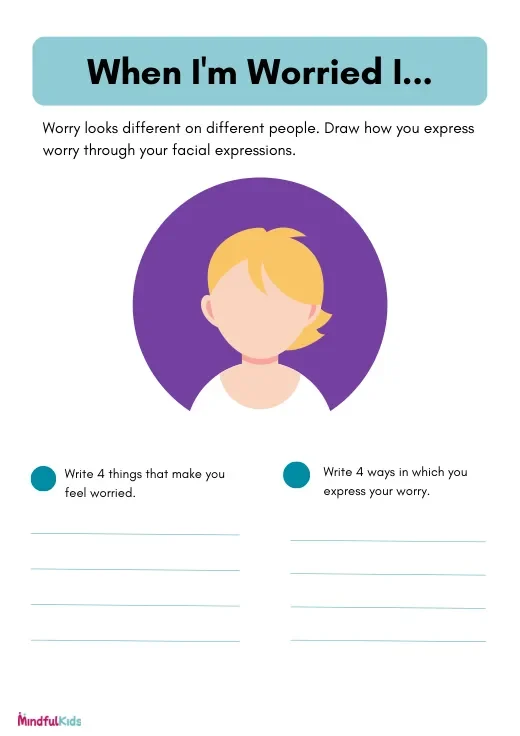
Say: “Everyone looks a bit different when they worry. Let’s find out what your worry looks like.”
Ask after: “What do you think the people around you notice when you are worried?”
3. Free From Worries – make a plan
Five short questions on one page: What makes you worry? When are you worried? What helps you? Who can help you? What can you do to feel better? By the end, the child has a small plan of their own, in their own words. You will find a filled-in example further down.
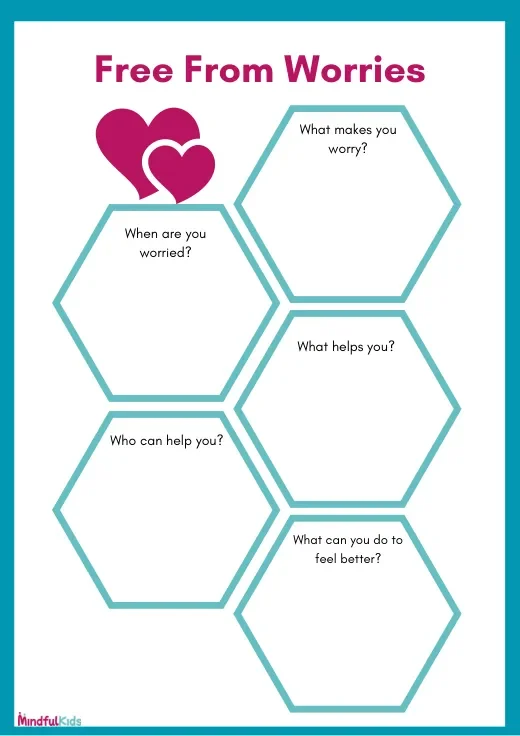
Say: “Let’s make a plan that is just for you.”
Ask after: “Which part of your plan do you want to try this week?”
4. The Worry Box and Let Go of Stress – give worries a place to wait
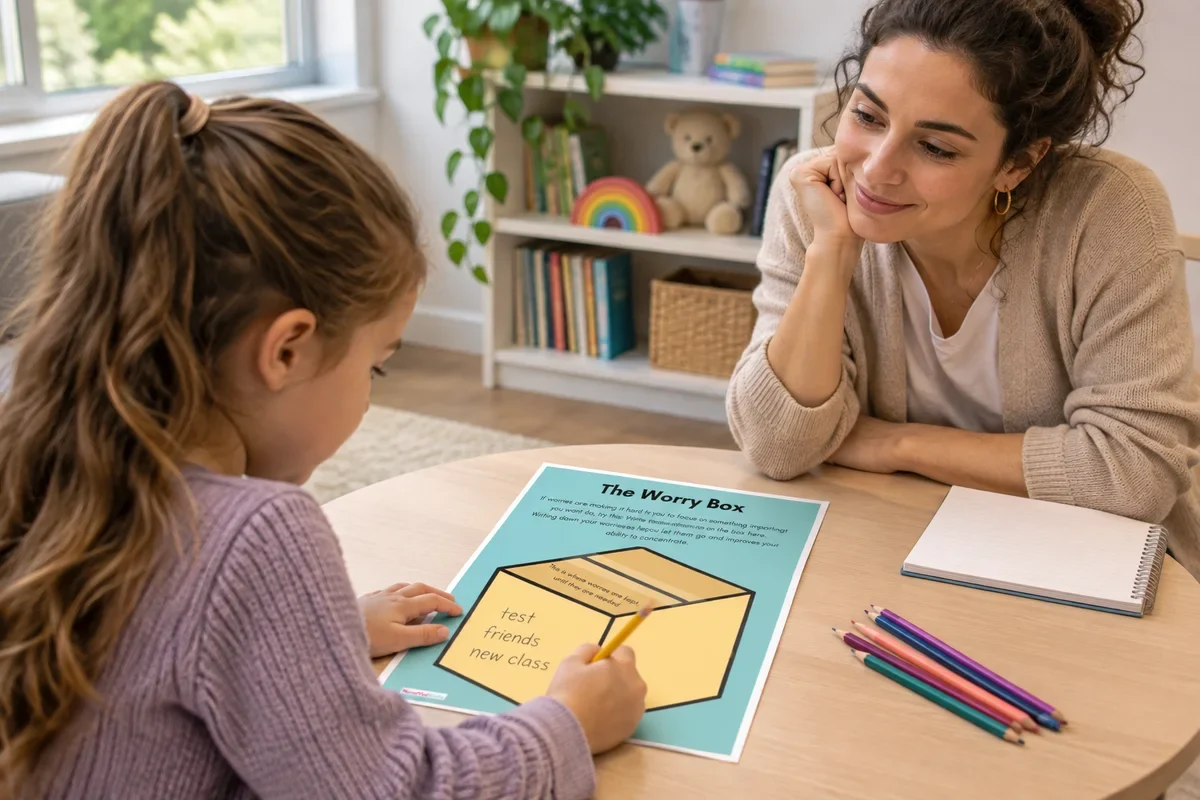
On the Worry Box page, the child writes their worries on a box “where worries are kept until they are needed”. On the Let Go of Stress page, they fill a jar. Then you agree on a set time to open the box or jar – at the end of the session, or at home with a parent. The NHS recommends the same idea. The child learns that worries can wait, so they take up less of the day.
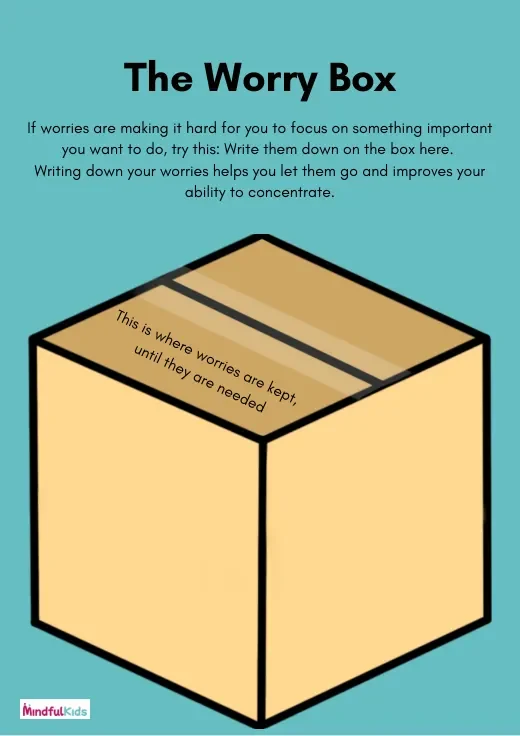
Say: “Your worries can wait in this box. We’ll open it together before you go.”
Ask after: “Which worry feels smaller now that it is in the box?”
5. Square Breathing and What Helps Me Feel Calm – build a calm toolbox
On the Square Breathing page, the child traces the sides of a square with a finger: breathe in for 4, hold for 4, breathe out for 4, hold for 4. On What Helps Me Feel Calm, they circle what works for them – drawing, a favourite blanket, music, a walk outside – and add their own ideas. Practise at the start of every session, so the tools are ready on hard days.
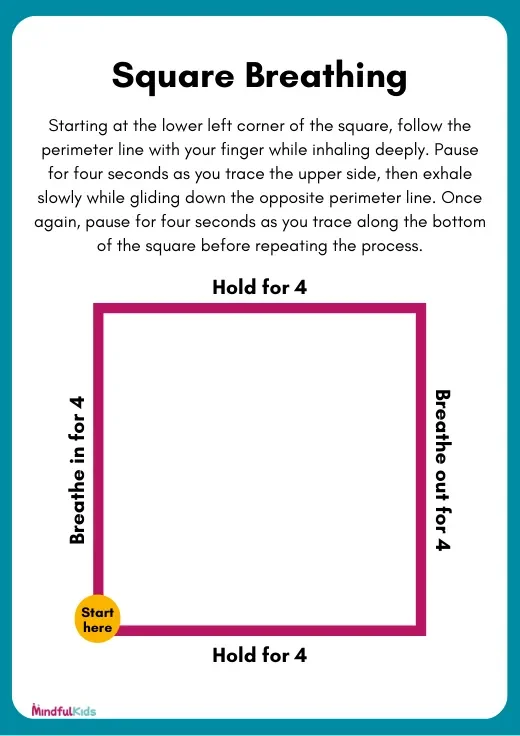
Say: “Let’s breathe around the square together. Smell the flower, blow out the candle.”
Ask after: “How does your body feel now?”
Smelling a flower for the in-breath and blowing out a candle for the out-breath make slow breathing easy to picture, especially for younger children.
Example: a filled-in Free From Worries page
Here is how a 7-year-old might fill in the Free From Worries page, while you write down the answers.
| Question on the page | What Noa (7) said |
|---|---|
| What makes you worry? | That Mum will be late to pick me up. |
| When are you worried? | In the last lesson before home time. |
| What helps you? | Holding my keyring. Square breathing. |
| Who can help you? | My teacher. She waits with us at the gate. |
| What can you do to feel better? | Breathe the square. Remember that Mum always comes. |
Notice that the worry did not disappear. Noa now has three things she can do and one person she can turn to. That is a big step for a 7-year-old – and she found it herself. You don’t need to solve the worry in one session. Helping the child find their own answers is the work.
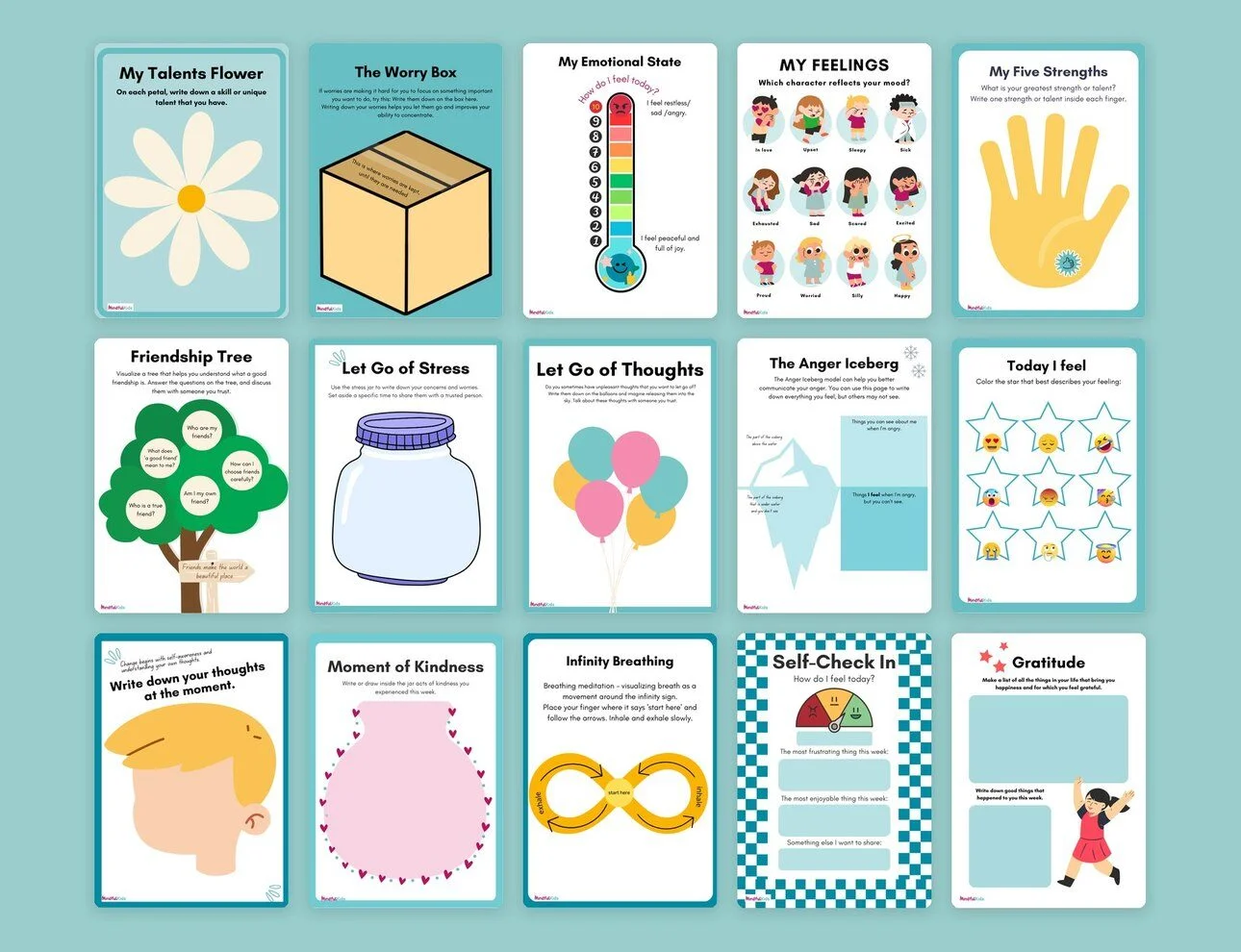
All these pages are in this kit
CBT & Mindfulness Kit for Kids (4–11)
Over 50 printable worksheets. Instant PDF download, 30-day money-back guarantee.
How do I run a worksheet session
Every session can follow the same rhythm:
- Let the child choose. Lay out two or three pages that fit where you are in the plan, and let the child pick one. Children engage more with a page they chose.
- Fill it in together. Sit next to the child. You can fill in your own copy too – children join in more easily when the adult takes part.
- Talk about it. Listen more than you speak. Reflect what you hear: “It sounds like the last lesson feels long.”
- Keep it safe. The child shared something personal. Keep the page in a folder that belongs to them.
- Look again later. After a few weeks, take the page out and compare. Children love to see how they have grown – and it shows you the progress too.
Three questions that work after any page: “What did you notice while filling it in?”, “Which part was the hardest?” and “What did you learn about yourself?”
Before the child arrives, put phones away, have pencils and a glass of water on the table, and keep the room quiet. A calm room makes it easier for the child to open up.
How often should I use them
One page per session works best, for as long as the child can stay focused – often 5 to 10 minutes for younger children, plus time to talk. Between sessions, a page the child already knows can go home as practice. If a child arrives very upset, breathe together first and do the page later.
A 4-session plan
| Session | Focus | Pages from the kit |
|---|---|---|
| 1 | Feel capable | My Five Strengths and Self-Check In (how am I feeling, how is my breathing). Learn square breathing. |
| 2 | Know the worry | When I’m Worried I…, then Free From Worries. |
| 3 | Give worries a place | The Worry Box or Let Go of Stress. Send a copy home with a set time to open it. |
| 4 | Build the calm toolbox | What Helps Me Feel Calm, The People Who Support Me (people the child can count on), and a look back at the session 2 pages. |
After four sessions, keep the pages the child liked most close by. Go back to the Worry Box whenever a new worry shows up.
What if a session gets stuck
It happens to everyone who works with children, and it is part of the process. A page can touch something sensitive, and the child goes quiet, gets upset or refuses.
- The child refuses: offer a choice between two pages, or start filling in your own copy. Many children join in once they see you do it.
- Strong feelings come up: stay calm and curious. “It’s okay to feel frustrated. I’m right here.” Breathe together or stretch, and come back to the page later – or next time.
- The child gives very short answers: that is fine. Reflect what you hear and ask one open question: “What else?”
The process matters more than the result. A session where the child fills in one line is still a good session. Praise the effort and go at the child’s pace.
How do I involve parents
Parents can make a big difference between sessions. In a UK trial of children aged 5–12, parents led CBT at home with short guidance from a professional, and NIHR reports that 50% of the children had recovered right after treatment and 69% after six months.
- Send home one page the child already knows, such as Square Breathing or the Worry Box.
- Explain it in two sentences: what the page is for and when to use it – for example, open the Worry Box together for ten minutes after dinner.
- Give parents one tip: listen to the worry first, praise the trying, and let the child take small brave steps instead of avoiding what feels hard.
Questions people ask
Are anxiety worksheets suitable for a 5-year-old?
Yes. Read the questions aloud, write the answers for the child and let them draw or point. Pages with pictures, like My Five Strengths or the Worry Box, work well at this age.
How long should one worksheet take in a session?
As long as the child can stay focused – often 5 to 10 minutes for younger children. Leave time for a short talk afterwards and don’t rush.
What is a worry box?
A worry box is a place where a child writes or draws their worries. At a set time, you open it together and talk them through, so the worries don’t fill the whole day.
Can I use the worksheets with a group?
Yes. Explain the purpose, let each child fill in the page on their own, and then invite – never require – sharing. Small groups of up to eight children work best.
Can I give the worksheets as homework?
Yes. Send home a page the child already knows from a session, such as Square Breathing or the Worry Box, and explain to the parent in two sentences what to do.
When a child answers every question with “fine”, see Emotions worksheets for kids (4–11).
Working with teenagers? See CBT worksheets for teens (12–18): a guide for therapists.
Worksheets for this topic
CBT & Mindfulness Kit for Kids (4–11)
Over 50 printable worksheets that help children name their feelings and calm worry. Instant PDF download, 30-day money-back guarantee.