
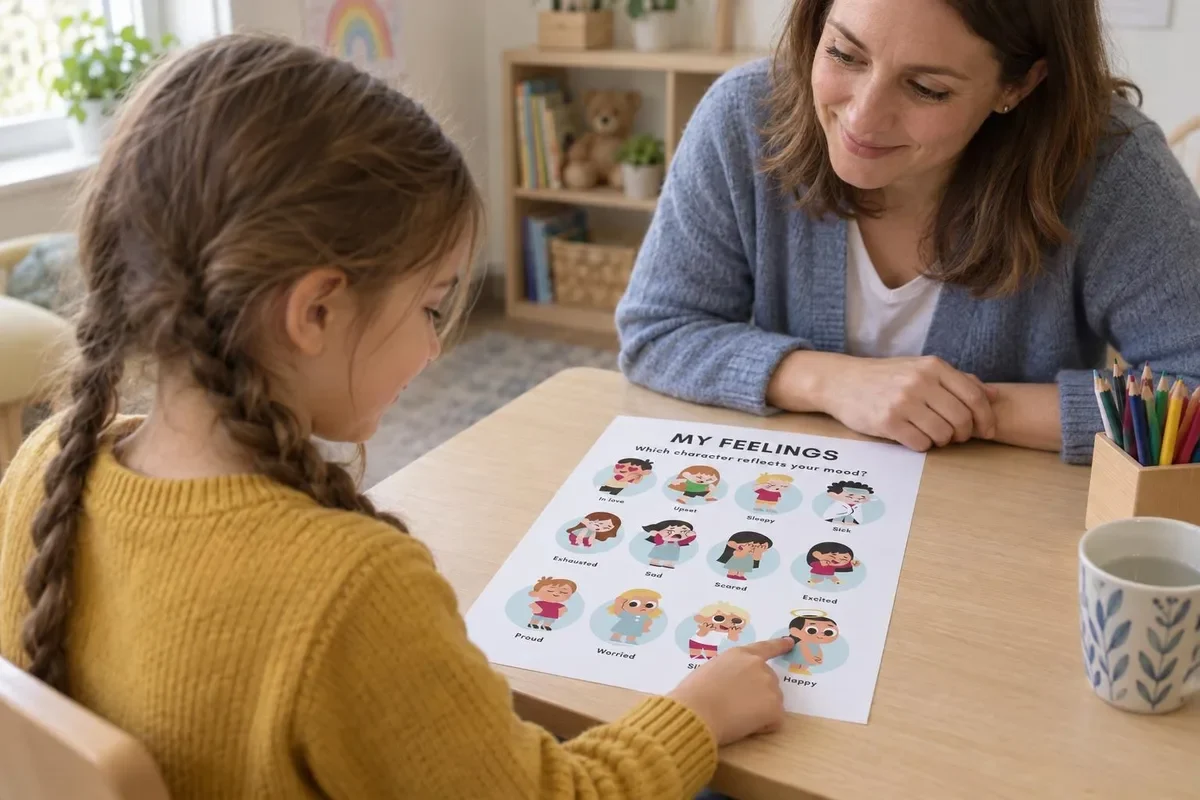
She sits on the edge of the chair, swinging her legs. You ask how her week was.
“Fine.”
You ask how she felt when her friend didn’t play with her. “Bad.” Then she looks at the window. It’s tempting to read that as a wall. Often it’s something simpler.
She may have run out of words.
When researchers tested how many feeling words children understand, the number doubled about every two years between the ages of 4 and 11. (Baron-Cohen et al., 2010) A 6-year-old may know half the feeling words of an 8-year-old. “Fine” and “bad” are sometimes the only two she has.
That makes your job simpler. Your task is to give her more words, and a few simple pages make that easy.
In short
Emotions worksheets help a child aged 4–11 name a feeling, see how big it is, notice it in the body and look at what sits underneath it. Naming a feeling is linked to calming down faster. Start with the step the child can already do, and move one step at a time.
Why naming comes first
Putting a feeling into words does more than describe it. In a study of 334 preschoolers, on days when children named their feelings more, they recovered faster from being upset that same day. (Zhu et al., 2026)
Brain scans in adults point the same way: naming a feeling turned down activity in the amygdala, the brain’s alarm system. (Lieberman et al., 2007)
And it adds up over time. Across many studies, children who understand emotions better tend to get on better with other children and show fewer behaviour problems. The links are modest but consistent. (Trentacosta & Fine, 2010) In one study, how well 5-year-olds could recognise and name emotions predicted their social behaviour and schoolwork four years later. (Izard et al., 2001)
So when a session “only” ends with a new word, it was a good session.
Four steps from “fine” to a feeling
Think of it as a ladder. Each step has one page. Most children start on step 1 or 2. Some are ready for step 4 on day one. You choose by listening, not by age.
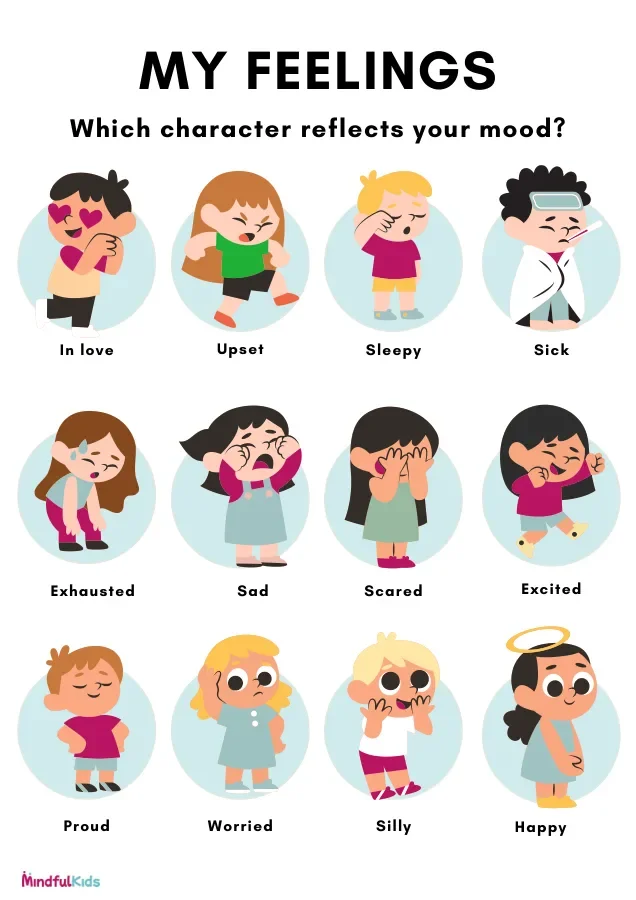
Step 1. Name it: My Feelings
Twelve little characters, each with a feeling under it: happy, scared, proud, worried, silly, exhausted and more. The child points to the one that fits today. No writing needed, so it works from age 4.
Start here if the child answers with one word, or with a shrug. Pointing is easier than talking.
In the room: “Which one of these kids looks a bit like you today?” Then: “What made you pick that one?”
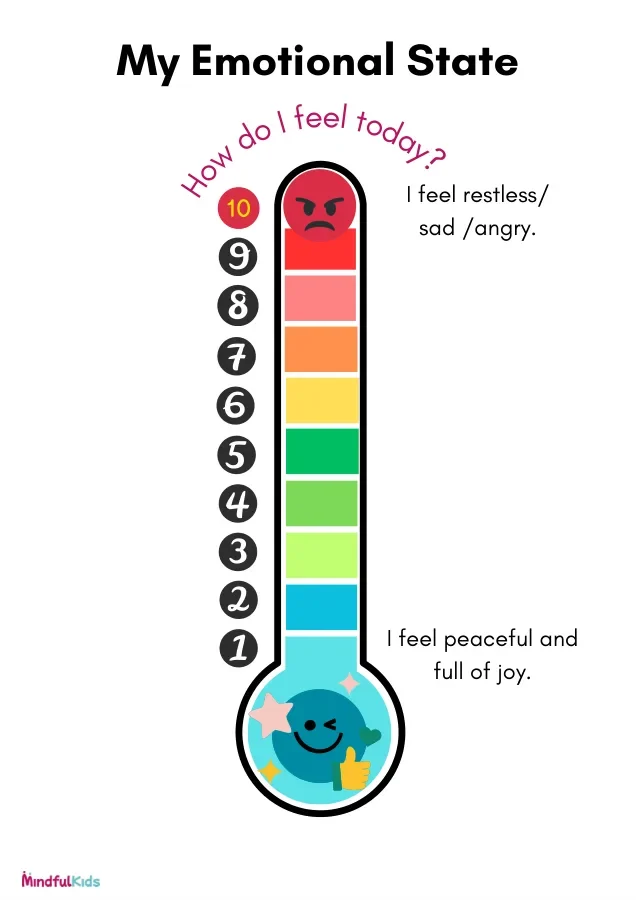
Step 2. Size it: My Emotional State
A thermometer from 1 to 10. At the bottom, “I feel peaceful and full of joy”. At the top, “I feel restless, sad or angry”. The child colours up to where they are.
Size matters as much as the name. “A bit cross” and “so angry I could scream” need different help. A number also lets you see change: a 9 last week and a 6 today is progress the child can see too.
In the room: “How high does it go today?” Later: “What would bring it down one number?”
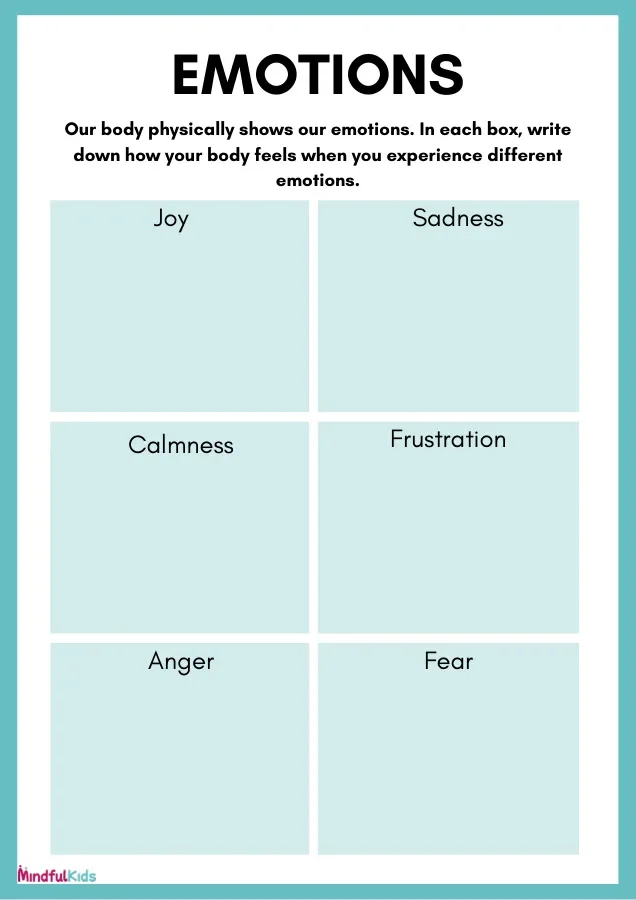
Step 3. Find it in the body: Emotions
Six boxes: joy, sadness, calmness, frustration, anger and fear. In each one, the child writes or draws how the body feels with that emotion. Hot face. Tight tummy. Heavy legs.
The body often notices first. In a study of 331 children and teens aged 6 to 17, children as young as 6 already linked happiness and fear to different feelings in the body. Those body maps became clearer and more specific with age. (Hietanen et al., 2016)
That’s good to know in the room. If a 6-year-old says “my tummy” for every feeling, she’s right on track. The details come with time and practice.
In the room: “When you’re scared, where in your body do you feel it first?”
Step 4. Look underneath: The Anger Iceberg
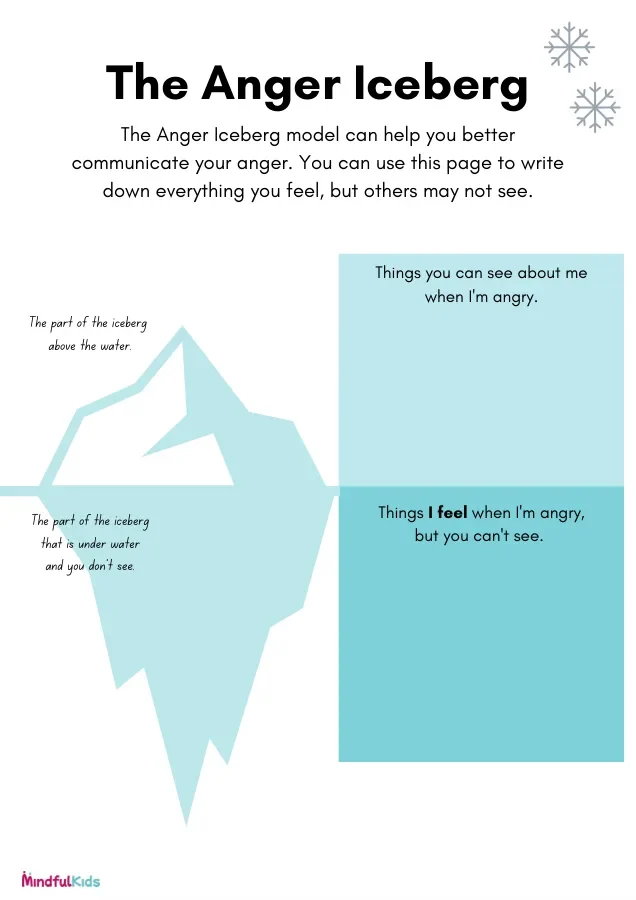
Anger is the feeling everyone sees. The iceberg page has two parts. Above the water: “Things you can see about me when I’m angry.” Below the water: “Things I feel when I’m angry, but you can’t see.”
This is the step where a child often surprises you. Under the shouting there may be embarrassment, jealousy or feeling left out. Once that has a name, it can be talked about, and the anger usually has less to do.
In the room: “Everyone can see the top part. What’s hiding under the water?”
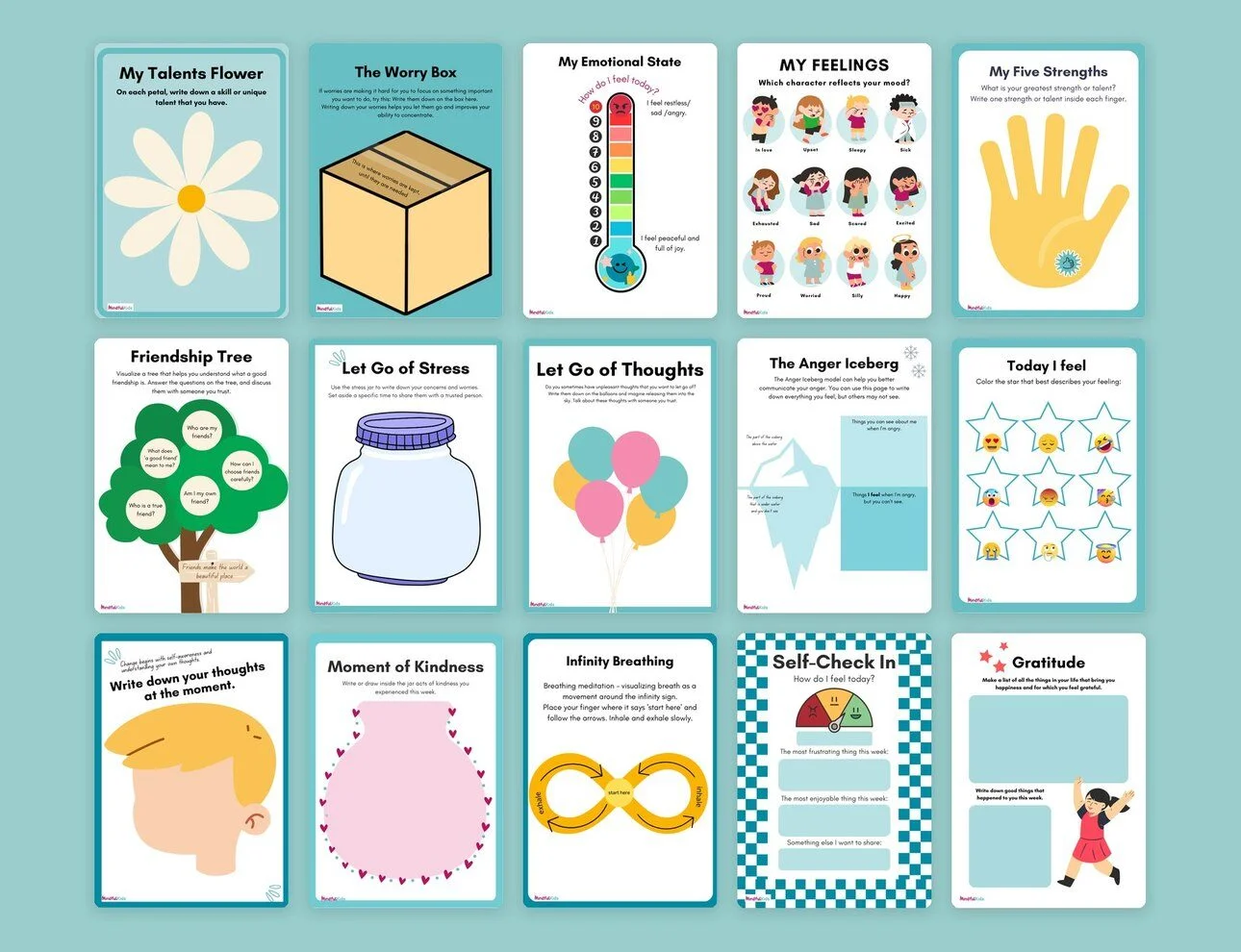
All these pages are in this kit
CBT & Mindfulness Kit for Kids (4–11)
Over 50 printable worksheets, with a full section on feelings. Instant PDF download, 30-day money-back guarantee.
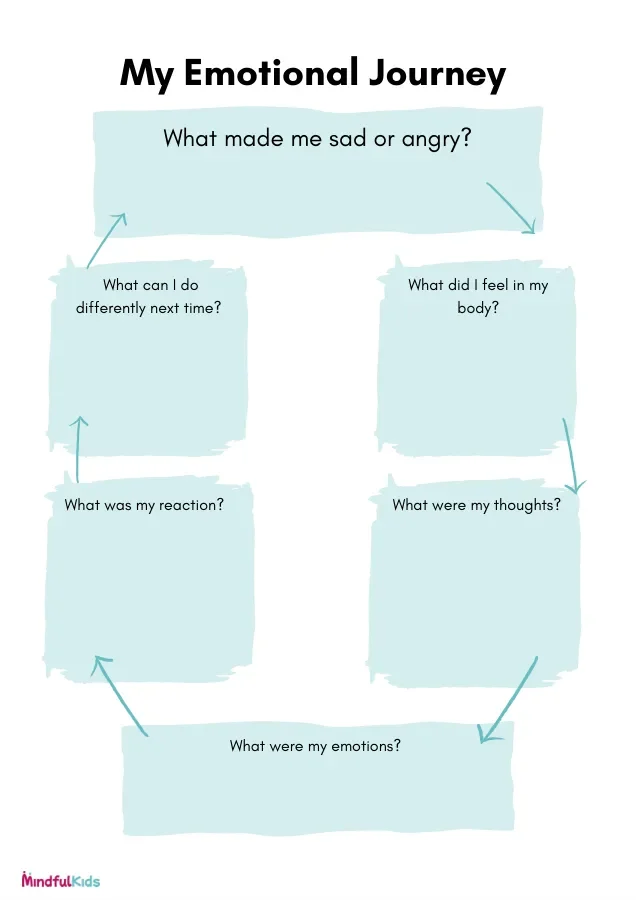
After a big feeling: My Emotional Journey
The four steps build the skill. This page uses it. It’s for the session after something happened: a fight at school, a meltdown at home.
The page is a loop of boxes. What made me sad or angry? What did I feel in my body? What were my thoughts? What were my emotions? What was my reaction? What can I do differently next time? The child fills them in one by one, like retelling a story.
The last box is the one that matters. It turns “I got in trouble” into “next time I could…”. Keep that answer small and real: “walk to the window” beats “never get angry again”.
One session, start to finish
Here’s how it can look. Sam is 8. His teacher says he “explodes” at break time. In your first session he says recess was “fine”.
- Minute 1–5: My Feelings. Sam points to “upset”, then quickly to “silly”. You notice both and say so.
- Minute 5–10: The thermometer. Yesterday at recess: 9. Right now: 3. He likes colouring the 9 red.
- Minute 10–20: The Anger Iceberg. Above the water: “I kicked the ball away. I shouted.” Below the water, after a long pause: “Nobody picked me for the team.”
- Minute 20–25: You name it together: left out. You don’t fix it yet. You tell him that’s a feeling a lot of kids have, and that it makes sense it turned into anger.
That’s enough for one session. Next time, the Emotional Journey page has a story to work with.
When the child says “I don’t know”
- Give two choices. “Was it more like scared or more like cross?” Choosing is easier than finding.
- Go to the body. “I don’t know” about feelings is often “I know” about the body. Ask where it was, not what it was.
- Name your own. “When my bus is late, I feel frustrated. My shoulders go up.” Children copy what they see.
- Let a character carry it. “How would this kid on the page feel if that happened to him?” Talking about someone else feels safer.
A page with one word on it is still a full page.
How to bring parents in
Parents can grow a child’s feeling words every day, without any worksheet. Suggest one habit: name feelings out loud during ordinary moments. “You look proud of that drawing.” “I think you’re disappointed the park is closed.” Ten seconds, several times a day.
You can also send the thermometer home. A child who colours it in each evening for a week brings you a week of real information, and a parent who asks “how high is it today?” has a better question than “how was your day?”.
Worksheets for this topic
CBT & Mindfulness Kit for Kids (4–11)
Over 50 printable worksheets that help children name, size and understand their feelings. Instant PDF download, 30-day money-back guarantee.
For short calming practices from the same kit, see Mindfulness for kids (4–11).
Questions people ask
What age are emotions worksheets for?
These pages are made for children aged 4–11. With 4–6-year-olds, use the pages that need no writing, like My Feelings, and let them draw. From about 7, most children can write a few words on the body and iceberg pages.
Which emotions worksheet should I start with?
Start with the step the child can already do. If they give one-word answers, start with naming (My Feelings). If they can name feelings but everything is “really really angry”, start with sizing (the thermometer).
How many feelings words does a child know?
It grows fast. In one study, the number of feeling words children understood doubled about every two years between ages 4 and 11. That’s why young children often use “fine”, “good” and “bad” for everything.
Does naming a feeling really help a child calm down?
Research suggests it does. Preschoolers who named their feelings more on a given day recovered faster from being upset that day, and in adults, naming a feeling lowered activity in the brain’s alarm system.
How often should I use these pages?
One page per session is plenty. A short check-in with the feelings page or thermometer at the start of every session builds the habit, and children soon start naming feelings without the page.
Sources
- Baron-Cohen S, et al. Emotion word comprehension from 4 to 16 years old: a developmental survey. Front Evol Neurosci, 2010. PubMed
- Zhu C, et al. Labeling it makes you feel better: the role of affect labeling on emotion regulation among Chinese preschoolers. Child Dev, 2026. PubMed
- Lieberman MD, et al. Putting feelings into words: affect labeling disrupts amygdala activity in response to affective stimuli. Psychol Sci, 2007. PubMed
- Trentacosta CJ, Fine SE. Emotion knowledge, social competence, and behavior problems in childhood and adolescence: a meta-analytic review. Soc Dev, 2010. PubMed
- Izard C, et al. Emotion knowledge as a predictor of social behavior and academic competence in children at risk. Psychol Sci, 2001. PubMed
- Hietanen JK, et al. Bodily maps of emotions across child development. Dev Sci, 2016. PubMed