

You tell her the drawing she brought is really good. She shrugs. “You’re just saying that to be nice.”
It’s a small moment, and it tells you a lot. A teen with low self-esteem doesn’t only think badly of herself. She also can’t let anything good in. Every compliment bounces off.
So more praise rarely works. What works is helping her find the evidence herself, slowly, in her own words. That’s what this guide is about.
In short
Self-esteem worksheets help a teen aged 12–18 notice how she talks to herself, try small brave actions and find strengths she already has. Work on three layers: what she thinks, what she does and what she has. Let her find the evidence, rather than giving it to her.
Why your work matters now
It’s the right moment. A review of longitudinal studies with more than 160,000 people traced self-esteem from age 4 to 94. Between 11 and 15 it sits at its lowest flat point, and after that it climbs strongly until about 30. (Orth et al., 2018) You meet her right where support helps her most, and you can help the climb start sooner.
It protects. Across 77 studies, low self-esteem predicted later depression more strongly than depression predicted later low self-esteem. (Sowislo & Orth, 2013) Helping a teen think more fairly about herself now can matter for years.
What low self-esteem looks like in the room
The workbook’s guide for therapists lists signs worth listening for. Teens rarely say “I have low self-esteem”. They say:
- “I’m so stupid. I can’t do anything right.” Putting herself down, often as a joke.
- “Oh, that was nothing. Anyone could have done it.” Pushing compliments away.
- “I’m not going to that club.” Saying no to new things she’s actually interested in.
Each one belongs to a different layer. Pick the layer where you hear the most.
Layer 1: what she thinks
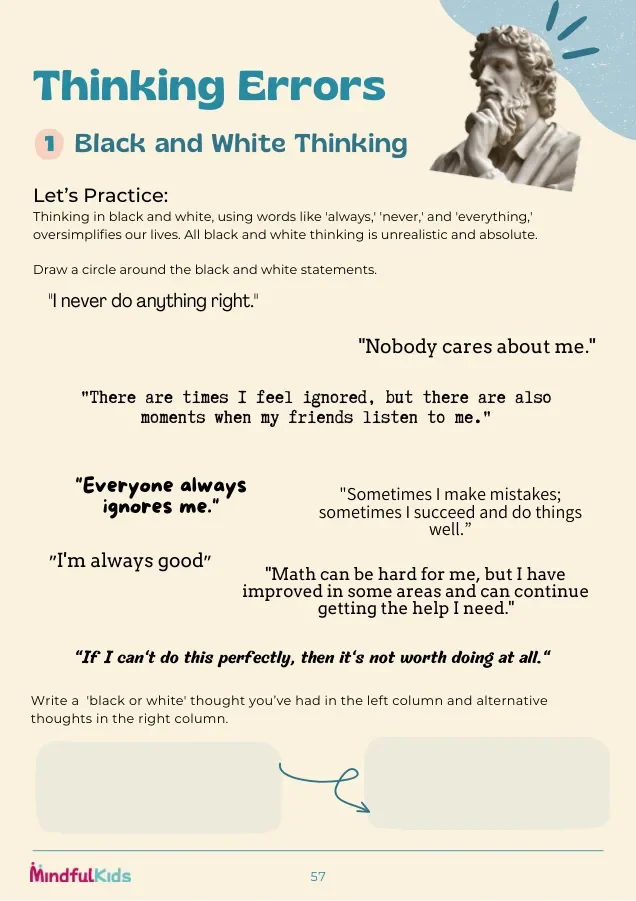
Black and White Thinking
The page lists sentences like “I never do anything right”, “Nobody cares about me” and “Sometimes I make mistakes; sometimes I succeed”. The teen circles the ones that are all-or-nothing. Then she writes one of her own and a fairer version next to it.
Starting with other people’s sentences matters. It’s easier to spot “always” and “never” in a sentence that isn’t yours. Once she can spot them on paper, she’ll start hearing them in her own voice.
Ask her: “Which of these sounds a bit like the voice in your head?”
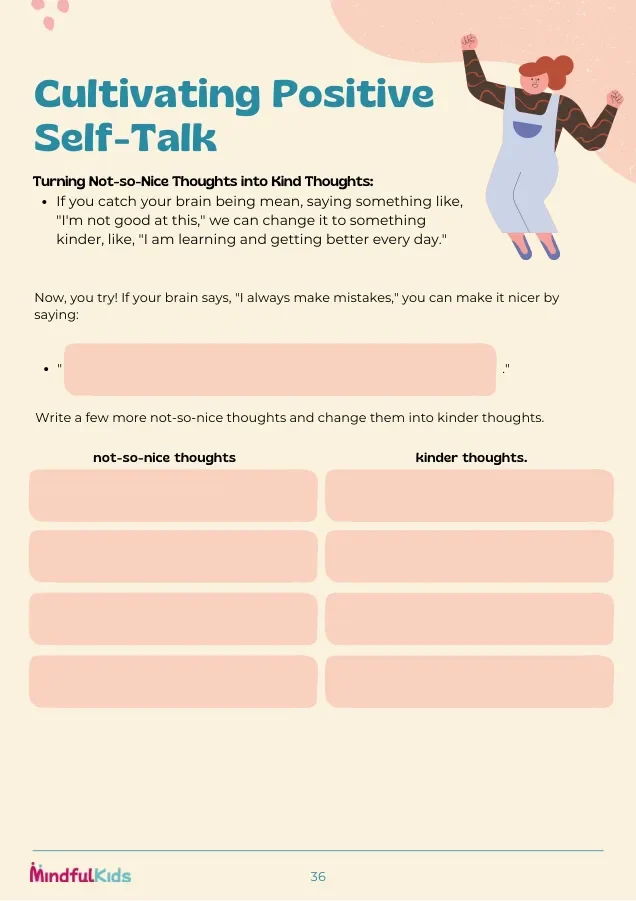
Cultivating Positive Self-Talk
Two columns: “not-so-nice thoughts” and “kinder thoughts”. The example: “I’m not good at this” becomes “I am learning and getting better every day.”
The goal isn’t fake positivity. It’s talking to herself the way she’d talk to a friend. That kind of self-kindness has a strong link with wellbeing. Across 19 studies with more than 7,000 teens, those who were kinder to themselves had much lower anxiety, depression and stress. (Marsh et al., 2018)
Ask her: “If your best friend said this about herself, what would you tell her?”
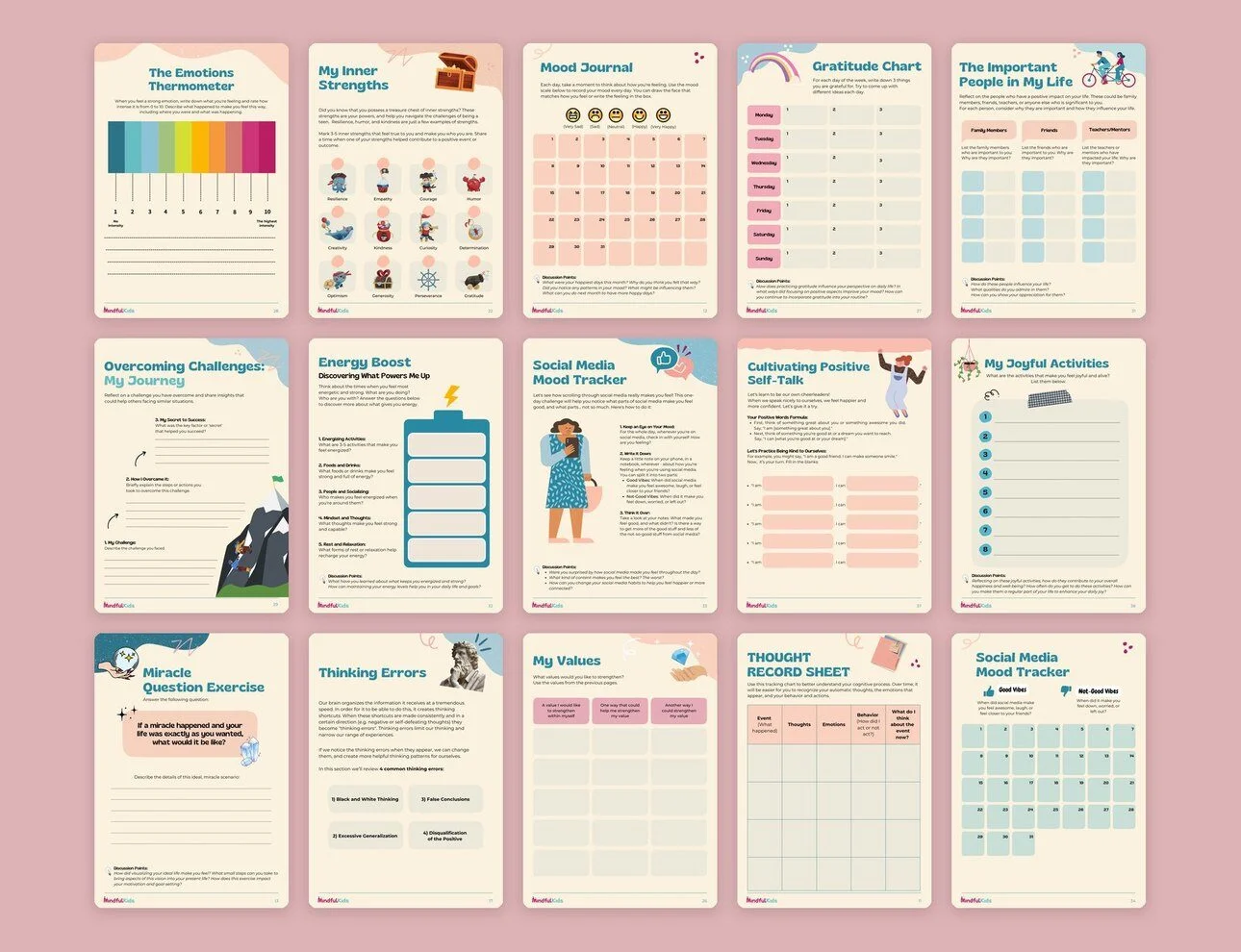
All these pages are in this workbook
Self-Esteem Workbook for Teens (12–18)
Over 80 printable pages, with a guide for therapists and a section for parents. Instant PDF download, 30-day money-back guarantee.
Layer 2: what she does
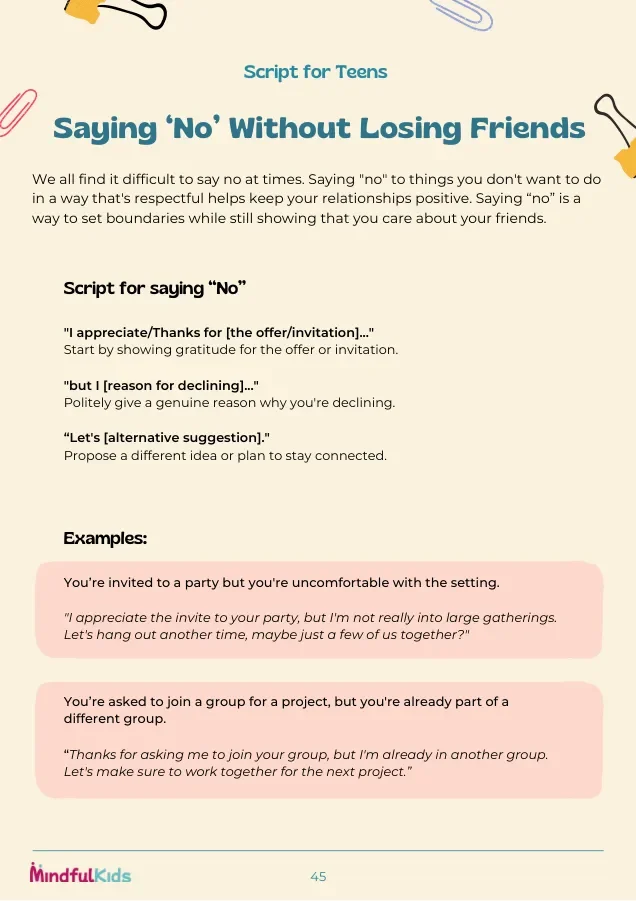
Saying ‘No’ Without Losing Friends
A three-part script: “Thanks for the invitation… but I… Let’s…” With examples, like turning down a big party and suggesting a smaller meet-up instead.
Many teens with low self-esteem say yes to everything, because no feels like a risk to the friendship. A script makes the risk smaller. She practises it with you first, where nothing is at stake.
Ask her: “Think of one thing you said yes to this week but wanted to say no. Let’s try the script on it.”
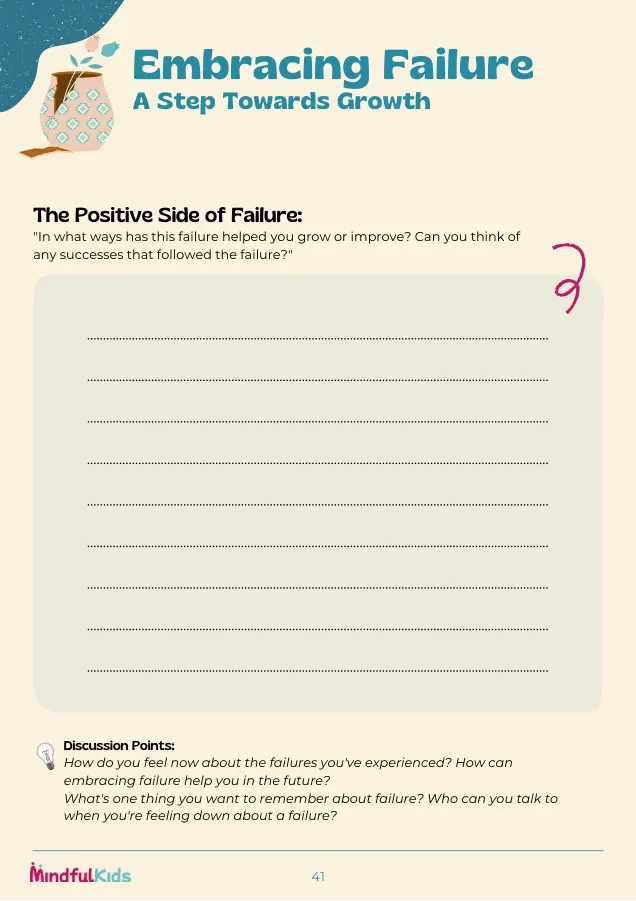
The Positive Side of Failure
One question fills most of the page: “In what ways has this failure helped you grow or improve? Can you think of any successes that followed the failure?” Below it, a few questions to talk about together.
Teens with low self-esteem often avoid new things because failing would “prove” what they already believe. This page doesn’t ask her to like failing. It asks her to look back at one failure she survived and see what came after it.
Ask her: “What’s something that went wrong a while ago that you’re okay with now?”
Layer 3: what she has
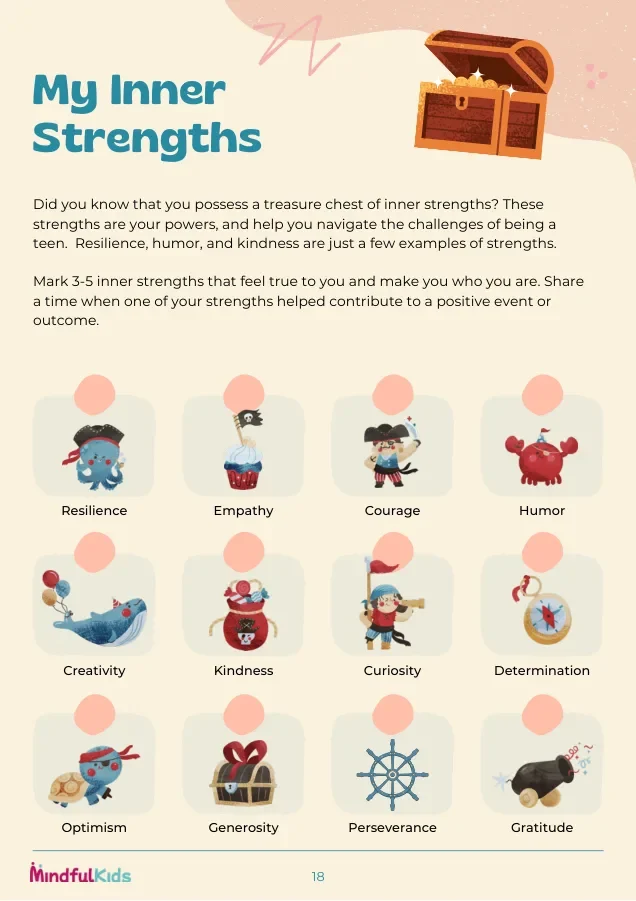
My Inner Strengths
Twelve strengths, each with a small picture: resilience, empathy, courage, humor, creativity, kindness, curiosity, determination, optimism, generosity, perseverance and gratitude. She marks three to five that feel true, then writes about a time one of them helped.
Notice the order: she chooses, then she proves it with her own story. That’s the opposite of a compliment, and it’s why it sticks. A strength she found herself is harder to bounce off.
Ask her: “Which one would your friends pick for you? Which one would you pick?”
Which layer first?
- She puts herself down a lot: start with layer 1, what she thinks.
- She avoids, people-pleases or won’t try: start with layer 2, what she does.
- She can’t name one good thing about herself: start with layer 3, what she has. It’s the gentlest way in.
Most teens move between all three over a few weeks. A session where she circles just one strength is a real step.
When a parent asks how to help
Parents often try to fix low self-esteem with praise, and their teen pushes it away just like she does in your room. Suggest they praise the effort or the specific thing, not the person. “You kept going on that essay even when it was hard” lands better than “you’re so smart”.
The workbook also has a full section for parents, with pages to help them reflect on their own teen years and on their relationship with their teen.
Worksheets for this topic
Self-Esteem Workbook for Teens (12–18)
Over 80 printable pages on strengths, self-talk, boundaries and social media. Instant PDF download, 30-day money-back guarantee.
Questions people ask
What are self-esteem worksheets for teens?
Short printable activities that help a teen notice how she talks to herself, practise small brave actions and find her strengths. They give the session a clear focus and something concrete to talk about.
Why doesn’t praise help a teen with low self-esteem?
Praise from outside often bounces off, because it doesn’t match what she believes about herself. Evidence she finds herself, in her own words and stories, is much harder to dismiss.
When is self-esteem lowest in teens?
A large review found self-esteem is at its lowest flat point between ages 11 and 15, then rises strongly until about 30. That makes the early teen years a valuable time for support.
Which self-esteem worksheet should I start with?
Start where you hear the most. If she puts herself down, start with self-talk. If she avoids things, start with saying no or failure. If she can’t name anything good, start with strengths.
What age is this workbook for?
It is made for teens aged 12–18, with a guide for therapists and a section for working with parents.
Sources
- Orth U, et al. Development of self-esteem from age 4 to 94 years: a meta-analysis of longitudinal studies. Psychol Bull, 2018. PubMed
- Sowislo JF, Orth U. Does low self-esteem predict depression and anxiety? A meta-analysis of longitudinal studies. Psychol Bull, 2013. PubMed
- Marsh IC, et al. Self-compassion and psychological distress in adolescents: a meta-analysis. Mindfulness, 2018. PubMed