

Her parents want a number. “How many hours should she be allowed?” They look at you as if you’ll know.
Research points to something more useful than a number: how she uses her phone, and at what age. Those two things are where the real difference lies.
How she uses her phone is something she can learn to change.
That gives you a clear job. Help her notice what scrolling does to her, and make her own changes. A four-week experiment does that well.
In short
Screen time worksheets help a teen aged 12–18 notice how social media affects her mood, check its effect on school and friends, shape her own feed and see comparison for what it is. How she uses her phone matters most. Treat it as her experiment, one week at a time.
Two things that make the difference
How she scrolls matters. In experiments with young adults, people asked to scroll passively, just looking at others’ posts, felt worse afterwards than those who used it actively, posting and chatting. The reason was envy. (Verduyn et al., 2015)
Age matters. A study following more than 17,000 young people found windows when heavy social media use predicted lower life satisfaction a year later. For girls, the window was around 11 to 13. For boys, around 14 to 15. (Orben et al., 2022) A 12-year-old girl and a 17-year-old boy may need quite different conversations.
A four-week experiment
Frame it as research, with her as the researcher. You’re not checking up on her. You’re both curious about what the data will show. Each week has one page.
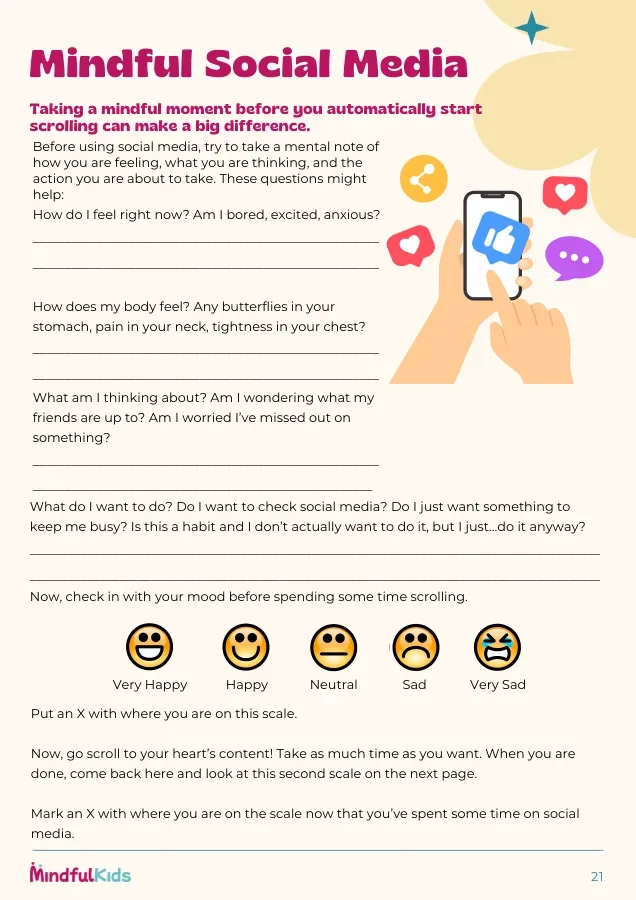
Week 1: Notice. Mindful Social Media
Before she opens an app, she answers four quick questions. How do I feel right now? How does my body feel? What am I thinking about? What do I want to do? She marks her mood on five faces, from very happy to very sad. Then she scrolls as long as she likes, and marks her mood again afterwards.
That’s the whole experiment for week one. Just two marks, before and after. Many teens are surprised by what the second mark shows, and a surprise she finds herself means far more than a warning from you.
Ask her: “What did you notice when you compared the two faces?”
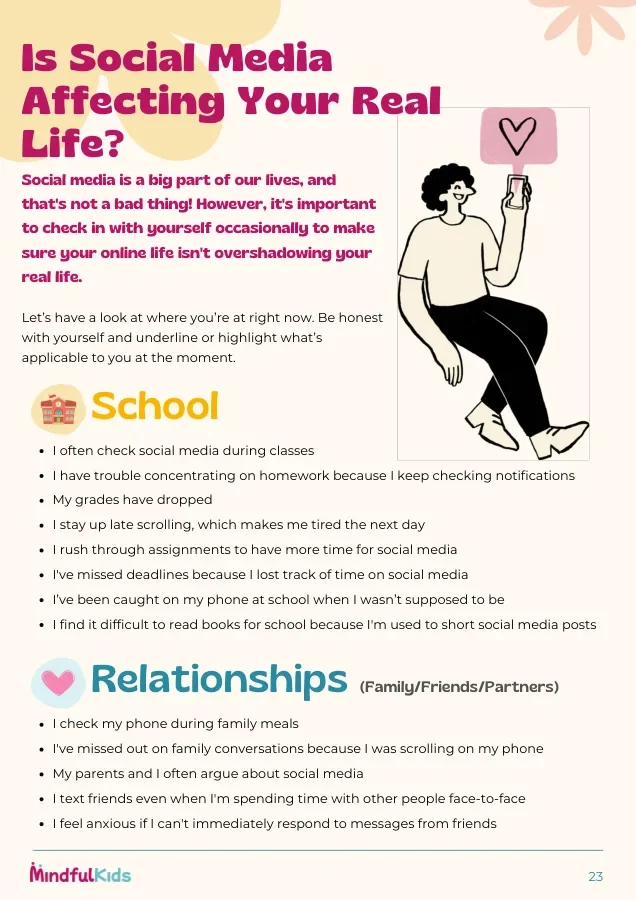
Week 2: Check. Is Social Media Affecting Your Real Life?
A list of statements, grouped by area, like school and relationships. “I stay up late scrolling, which makes me tired the next day.” “I text friends even when I’m spending time with other people face-to-face.” She highlights the ones that are true right now.
The page opens by saying social media is a big part of life, and that’s not a bad thing. That matters. She isn’t being judged. She’s just checking which parts of life are getting squeezed.
Ask her: “Where do you see the most impact? What’s one small thing you’d want to change there?”
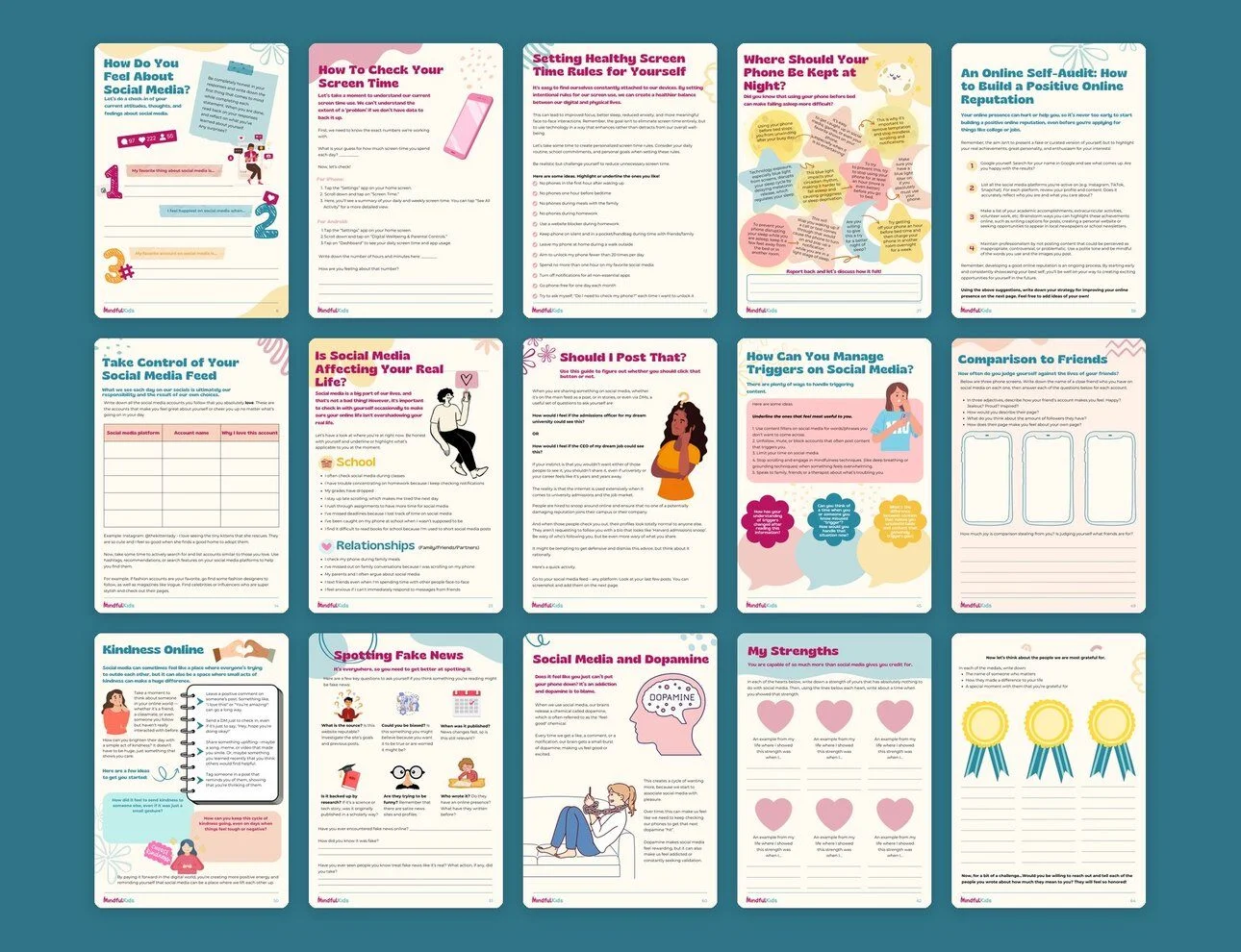
All these pages are in this workbook
Screen Time Workbook for Teens (12–18)
76 printable pages on screen time, social media and online wellbeing, with a section for parents. Instant PDF download, 30-day money-back guarantee.
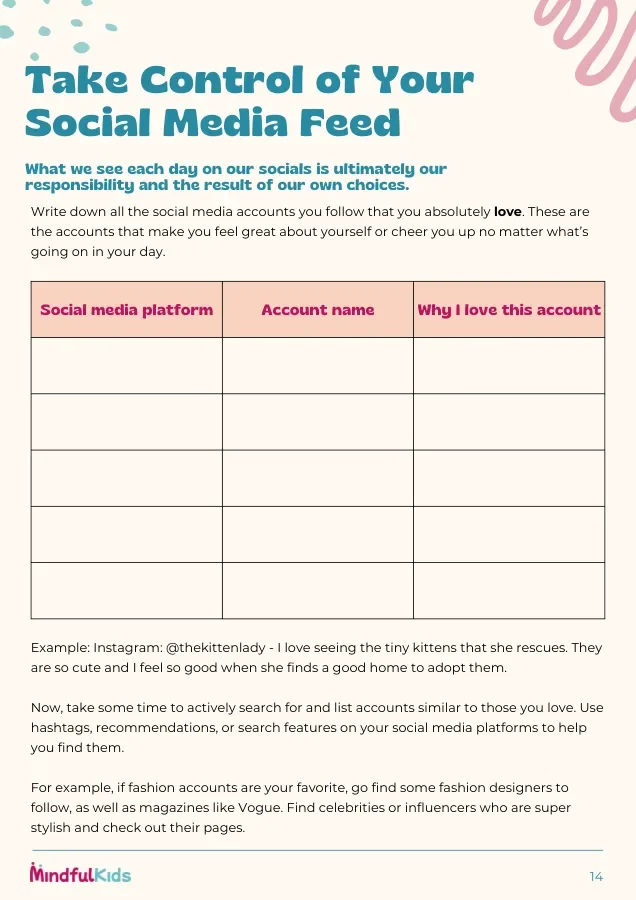
Week 3: Shape. Take Control of Your Social Media Feed
A table for the accounts she absolutely loves: the platform, the account name and why she loves it. Then she searches for more accounts like those, and adds them.
Notice what this page does first. It doesn’t start with what to delete. It starts with what’s good. Once her feed has more of what lifts her, unfollowing the accounts that drag her down feels like a smaller step.
Ask her: “Which account always makes you feel better? Let’s find three more like it.”
Week 4: Look closer. Comparison to Friends
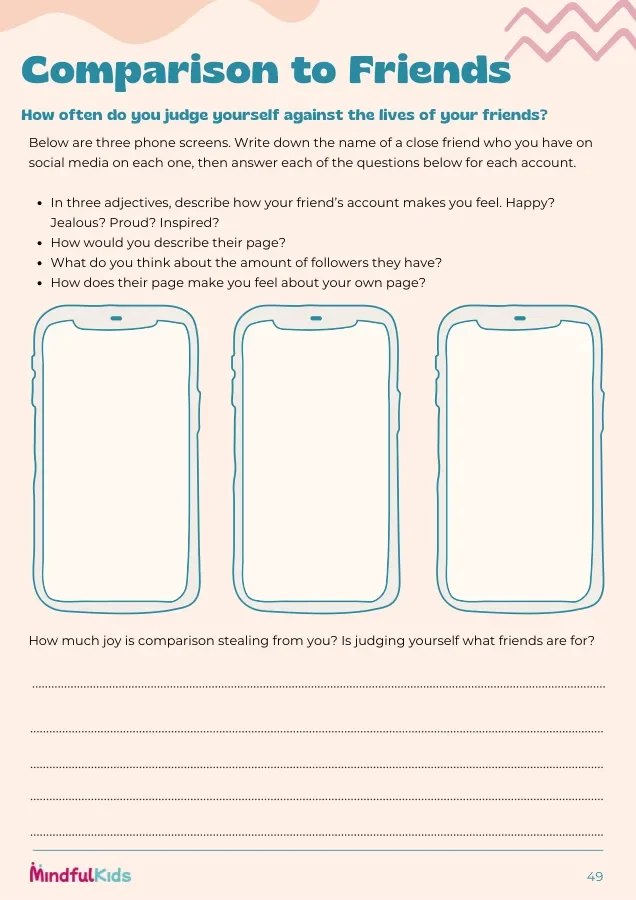
Three phone screens. On each, she writes the name of a close friend she follows. Then, for each one: three words for how their account makes her feel. Happy? Jealous? Inspired? And how does their page make her feel about her own?
This is the envy finding from above, made personal. She’ll often see that the friend she compares herself to most is also the one who leaves her feeling worst. The page ends with a question worth reading aloud: “Is judging yourself what friends are for?”
Ask her: “Which of these friends would be surprised to know how their page makes you feel?”
For the teen who posts a lot: Should I Post That?
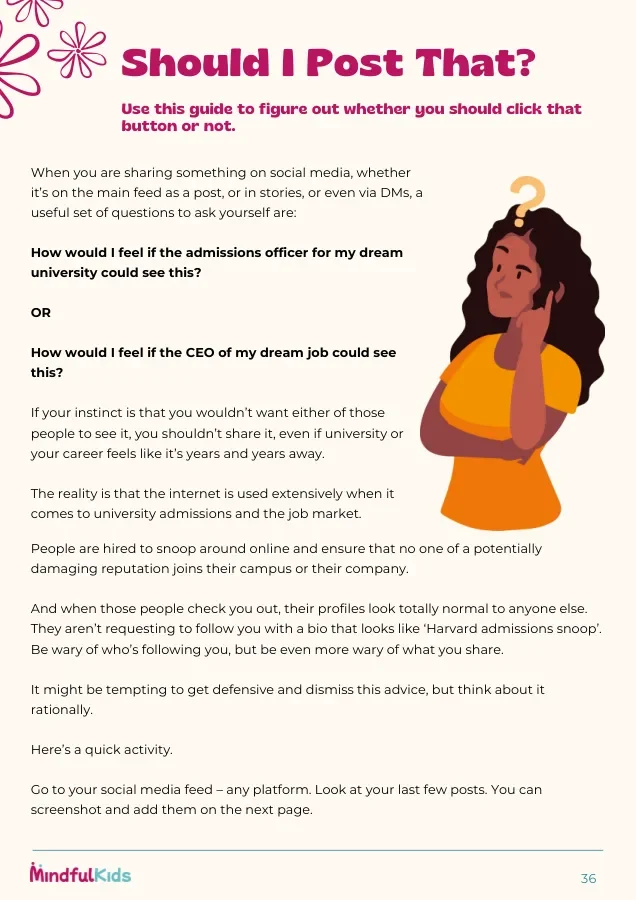
Some teens mostly look. Others mostly post. For the second group, this page offers one simple test before clicking share: how would I feel if the admissions officer at my dream university, or the boss at my dream job, saw this?
It works because it’s about her own future, not your rules. Then she looks back through her last few posts with that question in mind.
After four weeks
Put the pages side by side and ask her what she learned. Then let her choose one change to keep. One app off the home screen. The phone out of the bedroom at night. Three accounts unfollowed. A change she chose herself lasts much longer than one you set for her.
Helping parents step back from the number
The workbook’s section for parents is clear that a total ban is likely to backfire, and that forcing access to a teen’s accounts often just leads to a secret second account. It suggests talking about social media often, staying calm and open, and agreeing on house rules that apply to the whole family.
Share the two findings above too. They give parents something concrete to talk about with their teen: how she uses her phone, and how it makes her feel.
Worksheets for this topic
Screen Time Workbook for Teens (12–18)
76 printable pages that help teens build healthy habits with their phone and social media. Instant PDF download, 30-day money-back guarantee.
Questions people ask
How much screen time is too much for a teenager?
Research points less to one number and more to how a teen uses screens and at what age. Passive scrolling, and heavy use in the early teen years, are linked to lower wellbeing.
Is passive scrolling worse than posting?
Studies suggest it can be. People who scrolled passively felt worse afterwards than people who used social media actively, mainly because passive scrolling increased envy.
Should parents ban social media?
A total ban often backfires and can lead to secret accounts. Regular conversations, shared family rules and the teen’s own experiments tend to work better.
At what age is social media most sensitive?
One large study found windows of higher sensitivity around 11 to 13 for girls and 14 to 15 for boys, when heavier use predicted lower life satisfaction a year later.
What age is this workbook for?
It is made for teens aged 12–18, with a section for parents at the end.